Monday, June 16, 2025

The founder’s survival guide to B2B SaaS growth

The founder's survival guide to B2B SaaS growth

Here's the brutal truth: 90% of B2B SaaS companies fail because founders try to scale before they're ready, or they cling to tactics that worked at 10 customers when they have 100. If you're reading this, you probably know the feeling – that gnawing uncertainty about whether you should be hiring salespeople, launching that community, or finally implementing that pricing strategy you've been putting off.

The good news? The playbook exists. After analyzing recent case studies from companies like Notion, Figma, Linear, and dozens of emerging 2025 success stories, plus diving deep into founder psychology research, I've mapped the exact strategies that work at each critical growth stage. More importantly, I'll show you the mental shifts you need to make to avoid the psychological traps that kill most startups.

The three stages that matter

Every B2B SaaS company goes through three distinct growth phases, each requiring fundamentally different approaches:

  • Stage 1 (1-10 customers): The validation phase – proving people will pay for your solution
  • Stage 2 (10-100 customers): The pattern recognition phase – building repeatable growth systems
  • Stage 3 (100-500 customers): The scaling phase – optimizing for market leadership

The companies that make it understand one critical principle: the tactics that got you here won't get you there. What works brilliantly at 10 customers can kill your growth at 100. Let me show you exactly what to do at each stage.

Stage 1: Your first 10 customers (the validation phase)

The psychological reality

75% of startup leaders experience imposter syndrome at this stage, and honestly, that's probably healthy. You should feel uncertain – you're literally trying to prove that your vision of the world is correct. The founders who fail here make the mistake of trying to act like they have 1,000 customers when they have 10.

The mindset shift you need: From product-focused to problem-obsessed. Stop thinking about scaling and start thinking about one thing – are you solving a real problem people will pay to fix?

What actually works

Founder-led everything: You need to personally handle every customer conversation, support ticket, and sales call. This isn't inefficient – it's essential data collection. Figma's founders spent three years building in stealth mode with essentially one full-time customer (Coda). They drove personally to debug issues. That obsessive customer focus created the foundation for their $10B+ valuation.

The "renaissance rep" approach: When you do hire your first salesperson (after 10-20 deals personally), hire someone who can handle the entire sales cycle. Always hire two reps initially – you need to A/B test approaches and create internal benchmarks. Look for product believers over pure sales experience.

Community building starts now: But focus on existing communities, not creating new ones. Notion built their early community by being active in productivity forums and maker spaces. They didn't launch "Notion Community" – they became valuable members of communities that already existed.

Metrics that matter

  • Sean Ellis PMF Survey: Target >40% would be "very disappointed" without your product
  • Net Promoter Score: Aim for >50
  • Customer retention: >80% after 6 months
  • Time to first value: Track how quickly new customers get their "aha moment"

The transition trigger

Move to Stage 2 when you have consistent month-over-month customer growth, proven ability to replicate success, and reduced dependency on founder involvement in every sale. Most importantly, you should have clear understanding of your ideal customer profile.

Stage 2: 10-100 customers (the pattern recognition phase)

The psychological shift

This is where most founders develop false confidence – they think they've "figured it out" because they have some customers. The real challenge is delegation anxiety. You built everything yourself, and now you need to trust others with your baby.

The key insight: Your job changes from doing everything to building systems that let others do things. This feels terrifying, but it's necessary.

Growth strategies that scale

Community-led growth becomes your secret weapon: This is when community building truly pays off. Notion's "Notion Pros" program turned power users into evangelists. They got early access to features, direct communication with the product team, and resources for community events. Result? Over 90% of their traffic came from organic search and social media.

The template strategy: Airtable built 200+ pre-built templates with SEO-optimized landing pages. Each template solved a specific job-to-be-done and created organic discovery. This approach helped them reach 250,000 enterprises and a $5.77B valuation. Templates accelerate activation and reduce time-to-value.

Content marketing systematization: Move from founder-led content to content systems. Create 2-3 educational posts per week, comprehensive guides, customer case studies, and video content. Focus on building a "content library" where each piece builds on previous topics. Budget 10-15% of ARR on content marketing.

Sales evolution

Product-led growth with sales assistance: Companies like Calendly nailed this model. They built intrinsic virality into the product (every shared link promoted the product) while layering in sales for larger deals. 66% of B2B leaders using channel sales expect >11% revenue jump in 2025.

When to add your VP of Sales: Only after you have 2+ successful reps hitting quota consistently. The VP should initially carry quota themselves and focus on building repeatable processes, not being a "sales magician."

Pricing evolution

Move from simple pricing to good-better-best tiered pricing. Most successful companies at this stage use three tiers:

  • Basic: $49/month
  • Professional: $99/month
  • Enterprise: $199/month

Implement 10-20% annual price increases as you add value. Your customers expect it, and underpricing hurts more than it helps.

Customer success investment

Hire your first dedicated customer success manager after 25-30 customers. Budget 8-12% of ARR on customer success. Focus on onboarding optimization and churn prevention. Target net revenue retention of 100%+.

Critical metrics

  • Monthly recurring revenue growth: Target 10%+ month-over-month
  • Customer acquisition cost: $1,000-3,000 for B2B (varies by ACV)
  • CAC payback period: <12 months
  • Customer churn rate: <5% monthly
  • Net revenue retention: >100%

Stage 3: 100-500 customers (the scaling phase)

The mental game changes

This is where burnout risk peaks – 53% of founders experience burnout at this stage. You're transitioning from "owner of everything" to "leader of leaders," and it feels like losing control. The psychological challenge is enormous.

The mindset shift: From owner to leader. You must move from controlling everything to empowering others. This requires what psychologists call "progressive responsibility transfer" – gradually handing off areas with clear success metrics.

Advanced growth strategies

Account-based marketing sophistication: Multi-touch ABM campaigns for enterprise prospects, personalized outreach sequences, account-based advertising. Use intent data and predictive analytics for prospecting. This is where your earlier community building pays massive dividends.

Product-led growth optimization: Advanced in-product analytics, viral loops, self-service onboarding optimization. Track product-qualified leads (PQLs) and create automated expansion revenue identification. Focus on expansion revenue – it should be 30%+ of total revenue.

Channel partnerships become viable: This is when partnerships truly pay off. Top SaaS companies see 58% of sales coming from partners. Look for reseller programs, referral partnerships, integration partnerships, and service provider partnerships.

The delegation framework

Type 1 vs Type 2 decisions (Bezos framework):

  • Type 1: Irreversible, high-stakes (require deep founder consideration)
  • Type 2: Reversible, low-risk (delegate and adjust)

Hire true owners: Find VPs who can own functional areas completely. Consider hiring a COO to handle 20-40% of operations. Build a management layer that can make decisions without you.

Advanced metrics

  • Annual recurring revenue growth: 50-100%+ annually
  • Net revenue retention: Target 110-125%
  • Rule of 40: Growth rate + profit margin >40%
  • LTV:CAC ratio: 3:1 to 5:1
  • Customer lifetime value: $25K-100K+

Investment allocation

  • Sales: 15-25% of ARR
  • Marketing: 10-15% of ARR
  • Customer Success: 8-12% of ARR
  • R&D: 20-25% of ARR

The psychological survival guide

Common mental traps to avoid

The loyalty trap: 5-6 of your first 10 hires will remain at 50 employees, but only 2-3 will make it to 1,000. Don't keep people longer than their skills match company needs. This kills more scaling companies than any other single factor.

The hero complex: Believing you must solve every problem personally. This creates bottlenecks and prevents team development. Practice the "progressive responsibility transfer" – start with low-risk, high-learning delegation opportunities.

Perfectionism before scale: Stop over-engineering solutions before understanding true customer needs. Build for real problems, not imagined ones.

Mental health strategies that work

Build your support network immediately: Connect with other founders at your stage. Join groups or industry-specific communities. 72% of founders struggle with mental health issues – you're not alone, and peer support is proven to help.

Maintain customer contact: Don't lose touch with users as you grow. Schedule regular customer calls to stay connected to the problems you're solving.

Set real boundaries: Take actual vacations (2 weeks minimum per year), limit weekend work, and set a fair founder salary (average is $150K – don't underpay yourself).

Invest in professional help: Executive coaching, therapy, or advisory relationships. This isn't a luxury – it's essential infrastructure for scaling.

The 2025 market reality

What's changed

Longer sales cycles: Average B2B sales cycles increased 24% in 2025 due to economic uncertainty. Plan for 75+ day enterprise sales cycles.

Efficiency focus: The market rewards efficiency alongside growth. Track revenue per employee, not just growth rates. The new normal is 700 employees at $200M ARR ($300K revenue per employee).

AI integration opportunities: 71% of B2B buyers plan to invest in AI-powered software in 2025. Look for ways to integrate AI that actually improves user workflows, not just because it's trendy.

Community-led growth acceleration: Companies with dedicated community teams saw 22% growth rates vs. industry average of 19%.

Success patterns for 2025

Retention-first growth: Companies with 100%+ net revenue retention grow 1.8x faster than peers. Focus on expansion revenue over new customer acquisition after Stage 1.

Hybrid PLG models: Combine product-led growth with high-touch enterprise sales. The most successful 2025 companies use PLG for initial user acquisition and sales-assisted motion for expansion.

Community-driven content: User-generated content and community-driven product development create stronger moats than traditional marketing.

Your action plan

  1. Honest stage assessment: Which stage are you really in? Don't lie to yourself.
  2. Customer conversation audit: Are you still talking directly to customers weekly?
  3. Mental health check: When did you last take a real weekend off?
  4. Metric alignment: Are you tracking the right metrics for your stage?

Next 90 days

  1. Implement stage-appropriate systems: Don't build for future scale, build for current needs
  2. Start delegation experiments: Begin with low-risk, high-learning opportunities
  3. Build your founder support network: Find 2-3 peers at similar stages
  4. Customer success foundation: Implement retention processes if you haven't already

Long-term success habits

  1. Plan for psychological transitions: Each stage requires different mental frameworks
  2. Invest in leadership development: Your growth as a leader determines company growth
  3. Build sustainable practices: Systems that support long-term mental health
  4. Create legacy culture: Values that persist beyond founder involvement

The bottom line

Successful B2B SaaS scaling isn't about perfect execution – it's about executing the right tactics at the right stage. The companies that win understand that growth is as much psychological as it is operational. They invest in their mental health, build support networks, and adapt their strategies as they scale.

The data is clear: companies that systematically approach each growth stage with stage-appropriate strategies, while investing in founder psychological health, have a 3x higher chance of reaching $10M ARR. More importantly, their founders are still excited about running the business when they get there.

Your next move: Identify which stage you're really in, implement the core strategies for that stage, and start building the psychological foundation for the next one. The playbook exists – now it's time to execute it.

Remember: every successful B2B SaaS company started exactly where you are now. The difference is they understood that scaling is a game of stages, not just a race to grow faster.

https://bit.ly/4lehKVz
https://bit.ly/4l7aVEW


https://2.gravatar.com/avatar/b7ed20e10da488de193e75b40fa28ba5ceda96c4265525794861ddaa33ae7723?s=96&d=identicon&r=G
https://deepakguptaplus.wordpress.com/2025/06/16/the-founders-survival-guide-to-b2b-saas-growth/

Wednesday, June 11, 2025

The Economics of Authentication: Why Passwordless Pays

A Comprehensive Analysis of Total Cost of Ownership for Authentication Methods

The Economics of Authentication: Why Passwordless Pays

When I first started working on IAM back in 2010, one of the most frequent conversations I had with enterprise clients wasn't about features or security—it was about cost. CTOs and CISOs would sit across from me, spreadsheets open, trying to calculate whether investing in modern authentication would actually save them money. At the time, the business case for passwordless authentication seemed obvious to me from a security perspective, but the financial argument required careful analysis.

Over the years, I've seen firsthand how authentication costs compound across organizations. What looks like a simple technology decision on the surface reveals itself as a complex economic equation with far-reaching implications for business operations, user experience, and security posture.

Today, as I work with B2B SaaS companies at GrackerAI and help democratize AI access at LogicBalls, the economic case for passwordless authentication has become even more compelling. The hidden costs of traditional password-based systems are mounting, while the technology for passwordless solutions has matured to the point where implementation is both practical and cost-effective.

Understanding the True Cost of Authentication

Before we can evaluate different authentication methods, we need to understand that the "cost" of authentication extends far beyond the initial license fees or implementation costs. Think of authentication like the foundation of a building—when it fails, everything built on top of it suffers consequences.

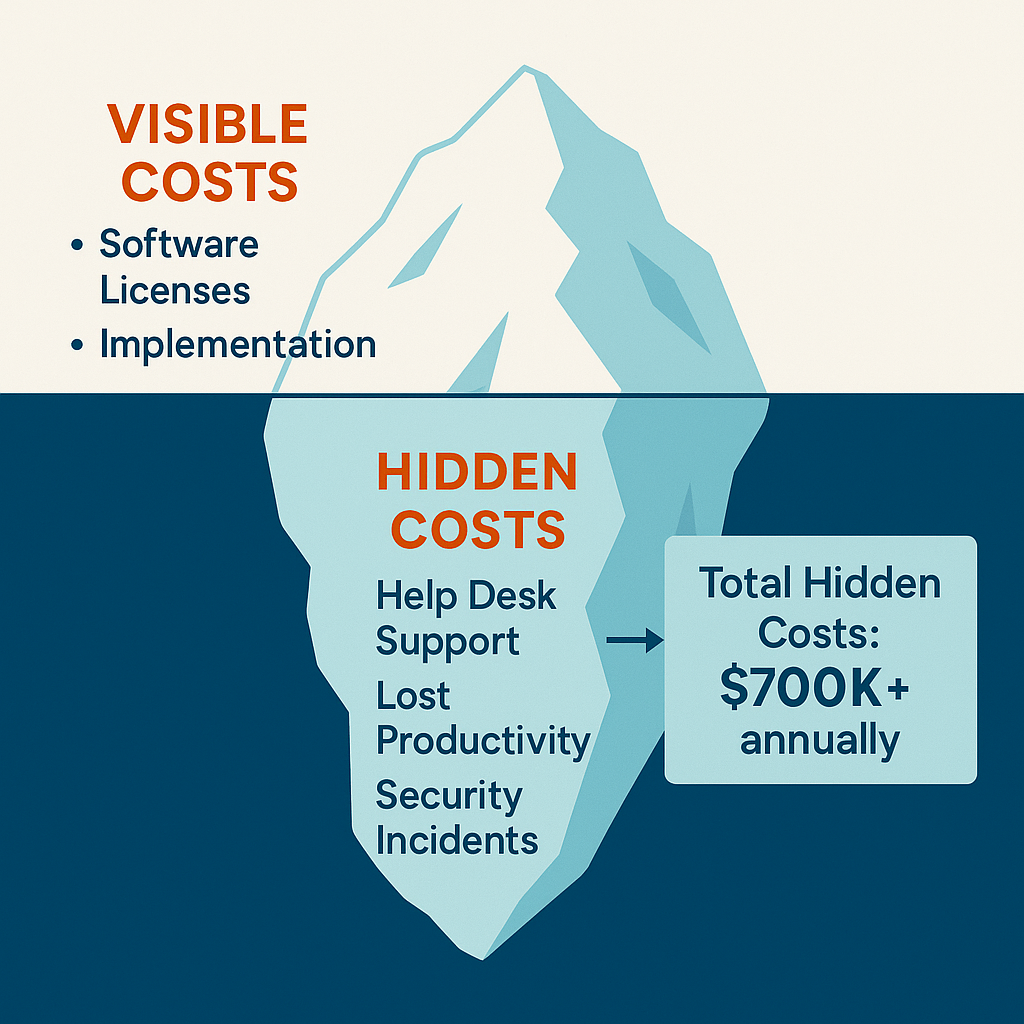
The total cost of ownership for authentication systems includes five major categories: direct implementation costs, operational overhead, security incident response, user productivity impact, and opportunity costs. Each category contains both visible expenses that appear on IT budgets and hidden costs that affect business operations in subtle but significant ways.

Consider a typical enterprise scenario: when an employee forgets their password, what seems like a minor inconvenience triggers a cascade of costs. The employee stops working and contacts the help desk. A support technician spends time verifying identity and resetting the password. The employee waits for the reset, potentially missing deadlines or losing momentum on critical projects. Meanwhile, the same scenario plays out dozens or hundreds of times across the organization every single day.

The Hidden Economics of Password-Based Systems

Password-based authentication creates what economists call "negative externalities"—costs that affect parties who didn't choose to incur them. When your sales team struggles with password resets during a critical client presentation, the cost isn't just the IT support time—it's the potential lost revenue from a delayed deal closure.

Let's examine the specific cost components that organizations often overlook when calculating authentication expenses.

Help Desk and Support Overhead

Industry research consistently shows that password-related issues account for 20-40% of all help desk tickets. In my experience working with enterprises, this figure often underestimated the true impact because it only counted direct password reset requests, not the secondary issues that password problems create.

A mid-sized company with 1,000 employees typically sees 50-100 password-related support tickets per month. With an average resolution time of 15 minutes and a fully-loaded help desk cost of $50 per hour, each incident costs approximately $12.50 in direct support time. This translates to $7,500-$15,000 monthly, or $90,000-$180,000 annually, just for basic password support.

However, these calculations miss the larger picture. Password complexity requirements force users to create passwords they can't remember, leading to increased reset frequency. Account lockouts cause cascading support issues as users attempt multiple login failures. Temporary passwords require additional verification steps and follow-up communications. When you factor in these secondary effects, the true cost of password support often doubles.

User Productivity Loss

The productivity impact of authentication issues represents one of the largest hidden costs in most organizations. Every minute an employee spends dealing with password problems is time not spent on revenue-generating activities. For knowledge workers earning $75,000 annually, each minute costs the organization approximately $0.60 in lost productivity.

Research from Microsoft and other major technology companies suggests that the average knowledge worker spends 12-15 minutes per week dealing with password-related issues. This includes time spent trying to remember passwords, resetting forgotten credentials, and managing password complexity requirements across multiple systems.

For our hypothetical 1,000-employee organization, this represents 750-937 hours of lost productivity monthly, valued at approximately $45,000-$56,000. Annually, password-related productivity loss costs between $540,000 and $675,000—often exceeding the entire authentication technology budget.

Security Incident Response and Breach Costs

Perhaps the most significant hidden cost comes from security incidents related to weak password practices. The 2023 IBM Cost of a Data Breach Report found that compromised credentials were responsible for 19% of all data breaches, with an average cost of $4.45 million per incident.

While not every organization will experience a major breach, the risk calculation is straightforward: even a 1% annual probability of a credential-related breach represents an expected cost of $44,500 per year for our example organization. When you consider that password reuse, weak passwords, and social engineering attacks specifically target password-based authentication weaknesses, this risk assessment becomes conservative.

Additionally, organizations must invest in compensating security controls when using password-based systems. Multi-factor authentication, password complexity enforcement, account monitoring, and suspicious activity detection all represent additional costs that passwordless systems can eliminate or significantly reduce.

Comparative Cost Analysis: Traditional vs. Passwordless

To understand the economic advantages of passwordless authentication, we need to compare the total cost of ownership across different implementation approaches. Let's examine three common scenarios: traditional password systems, password-plus-MFA implementations, and full passwordless solutions.

Traditional Password Systems

Traditional password-only authentication appears cost-effective initially because most organizations already have these systems in place. However, the ongoing operational costs quickly accumulate:

Annual help desk costs range from $90,000 to $180,000 for password-related support tickets. User productivity loss adds another $540,000 to $675,000 annually. Security tooling to compensate for password weaknesses—including monitoring systems, account lockout policies, and password strength validation—typically costs $25,000 to $50,000 in licensing and management overhead.

The expected cost of security incidents adds approximately $44,500 annually when calculated as a risk-adjusted expense. Additional administrative overhead for password policy management, user training, and compliance reporting contributes another $15,000 to $30,000 yearly.

The total annual cost for traditional password systems in our example organization ranges from $714,500 to $979,500, with most costs hidden in operational inefficiencies rather than visible technology expenses.

Password-Plus-MFA Hybrid Systems

Adding multi-factor authentication to existing password systems improves security but introduces new costs while maintaining most password-related expenses. MFA licensing typically costs $3-8 per user monthly, adding $36,000 to $96,000 annually for our 1,000-employee organization.

Implementation and integration costs for MFA systems range from $50,000 to $150,000 depending on complexity and the number of integrated applications. Ongoing support complexity increases because users now manage both passwords and MFA devices, often increasing help desk tickets by 15-25% during the first year of implementation.

While MFA significantly reduces the risk of credential-based breaches, it doesn't eliminate password-related productivity loss or support overhead. Users still forget passwords, still struggle with complexity requirements, and still require password resets. The total annual cost for password-plus-MFA systems ranges from $850,000 to $1,200,000, representing a 15-25% increase over password-only systems.

Passwordless Authentication Systems

Passwordless systems eliminate passwords entirely, using biometrics, hardware tokens, push notifications, or cryptographic certificates for authentication. While implementation costs are higher initially, operational savings quickly offset the investment.

Modern passwordless solutions cost $5-15 per user monthly, translating to $60,000-$180,000 annually in licensing fees. Implementation typically requires $100,000 to $300,000 for integration, user migration, and system configuration. However, operational costs drop dramatically.

Help desk tickets for authentication issues decrease by 75-90% because users cannot forget biometrics or lose cryptographic certificates stored on their devices. User productivity loss drops proportionally, saving $400,000 to $600,000 annually. Security incident risk decreases significantly because passwordless systems eliminate the most common attack vectors for credential theft.

The total annual cost for passwordless systems ranges from $250,000 to $450,000 after the first year, representing savings of 50-65% compared to traditional password systems.

Developing a Cost Comparison Framework

To help organizations evaluate authentication economics specific to their environment, I've developed a comprehensive cost calculator that accounts for both visible and hidden expenses. This framework considers organizational size, user behavior patterns, security requirements, and implementation complexity.

The calculator evaluates five cost categories across different time horizons. Direct costs include licensing fees, implementation services, and hardware requirements. Operational costs encompass help desk support, user training, and system administration. Security costs factor in incident response, compliance requirements, and compensating controls. Productivity costs calculate time lost to authentication issues and user friction. Finally, opportunity costs consider the business impact of delayed projects, frustrated users, and security constraints on innovation.

For each category, the framework applies industry benchmarks adjusted for organizational characteristics. A technology company with high-value knowledge workers will see greater productivity cost impact than a manufacturing organization with primarily operational roles. Companies in regulated industries face higher compliance and security costs. Organizations with distributed workforces experience different support and implementation challenges than centralized operations.

The calculation methodology uses Monte Carlo simulations to account for variability in cost factors. Password reset frequency varies seasonally and with organizational changes. Security incident probability changes based on threat landscape evolution. User productivity impact depends on role-specific authentication requirements and technology proficiency.

Industry-Specific Economic Considerations

Different industries experience varying authentication cost profiles based on regulatory requirements, user behavior patterns, and business models. Financial services organizations face strict compliance requirements that increase both implementation complexity and the cost of security failures. Healthcare systems must balance HIPAA compliance with user experience, often creating additional authentication friction that impacts productivity.

Technology companies typically see the highest productivity costs from authentication friction because their knowledge workers command premium salaries and authentication issues directly impact software development and customer support activities. Manufacturing organizations often find that authentication problems affect production systems and industrial processes, creating safety and operational efficiency concerns beyond traditional IT costs.

Retail and hospitality businesses face unique challenges with high employee turnover requiring frequent authentication system onboarding and offboarding. Educational institutions must manage authentication for diverse user populations including students, faculty, and administrative staff with different access patterns and technical proficiency levels.

Implementation Strategy and ROI Timeline

The economic benefits of passwordless authentication don't materialize immediately. Organizations typically see a J-curve effect where costs increase initially due to implementation expenses before declining as operational savings accumulate.

Month one through six represent the implementation phase, where organizations invest in technology, integration, and user migration while maintaining parallel authentication systems. Costs peak during this period but productivity benefits begin emerging as early adopters experience reduced authentication friction.

Months six through twelve represent the transition phase, where operational costs start declining as password-related support tickets decrease and users adapt to passwordless workflows. Security benefits begin materializing as attack surface reduction takes effect.

Year two and beyond represent the optimization phase, where full economic benefits emerge. Organizations typically achieve complete return on investment within 18-24 months, with ongoing annual savings continuing indefinitely.

Risk-Adjusted Economic Analysis

When evaluating authentication investments, organizations must consider not just average costs but also risk-adjusted scenarios. The economic impact of a major security breach far exceeds normal operational costs, making the risk reduction benefits of passwordless authentication particularly valuable.

A comprehensive economic analysis should model multiple scenarios including best-case operational efficiency gains, worst-case security incident costs, and most-likely average operational savings. This approach helps organizations understand the full range of economic outcomes and make informed investment decisions based on their risk tolerance and business objectives.

The economic case for passwordless authentication becomes particularly compelling when organizations consider the accelerating costs of password-based systems. As cyber threats increase in sophistication and frequency, the security costs of password systems continue rising. Simultaneously, user expectations for seamless digital experiences make password friction increasingly expensive from a productivity and user satisfaction perspective.

Conclusion: The Economic Imperative

After analyzing authentication costs across hundreds of organizations, the economic argument for passwordless authentication has become undeniable. Organizations that continue relying on password-based systems are essentially choosing to pay a "password tax" that compounds annually.

The calculation is straightforward: passwordless systems eliminate 70-80% of authentication-related operational costs while significantly reducing security risks and improving user productivity. For most organizations, the annual savings exceed the implementation investment within 18-24 months, with ongoing benefits continuing indefinitely.

The question isn't whether passwordless authentication saves money—it's whether organizations can afford to delay implementation while competitors gain economic advantages through operational efficiency and enhanced security posture.

As technology leaders, we have a responsibility to make decisions based on comprehensive economic analysis rather than intuitive assumptions about cost and complexity. The data clearly shows that passwordless authentication represents not just a security improvement but a significant economic opportunity for organizations willing to invest in modern identity infrastructure.

The future of authentication economics is clear: organizations that embrace passwordless systems today will enjoy sustained competitive advantages through lower operational costs, improved security posture, and enhanced user experiences. Those that delay will find themselves paying an increasingly expensive premium for outdated password-based approaches while missing opportunities for innovation and growth.

https://bit.ly/4jNbpiI
https://bit.ly/4jNbpPK


https://2.gravatar.com/avatar/b7ed20e10da488de193e75b40fa28ba5ceda96c4265525794861ddaa33ae7723?s=96&d=identicon&r=G
https://deepakguptaplus.wordpress.com/2025/06/12/the-economics-of-authentication-why-passwordless-pays/

Monday, June 9, 2025

Identity’s New Frontier: AI, Machines, and the Future of Digital Trust

Identity's New Frontier: AI, Machines, and the Future of Digital Trust

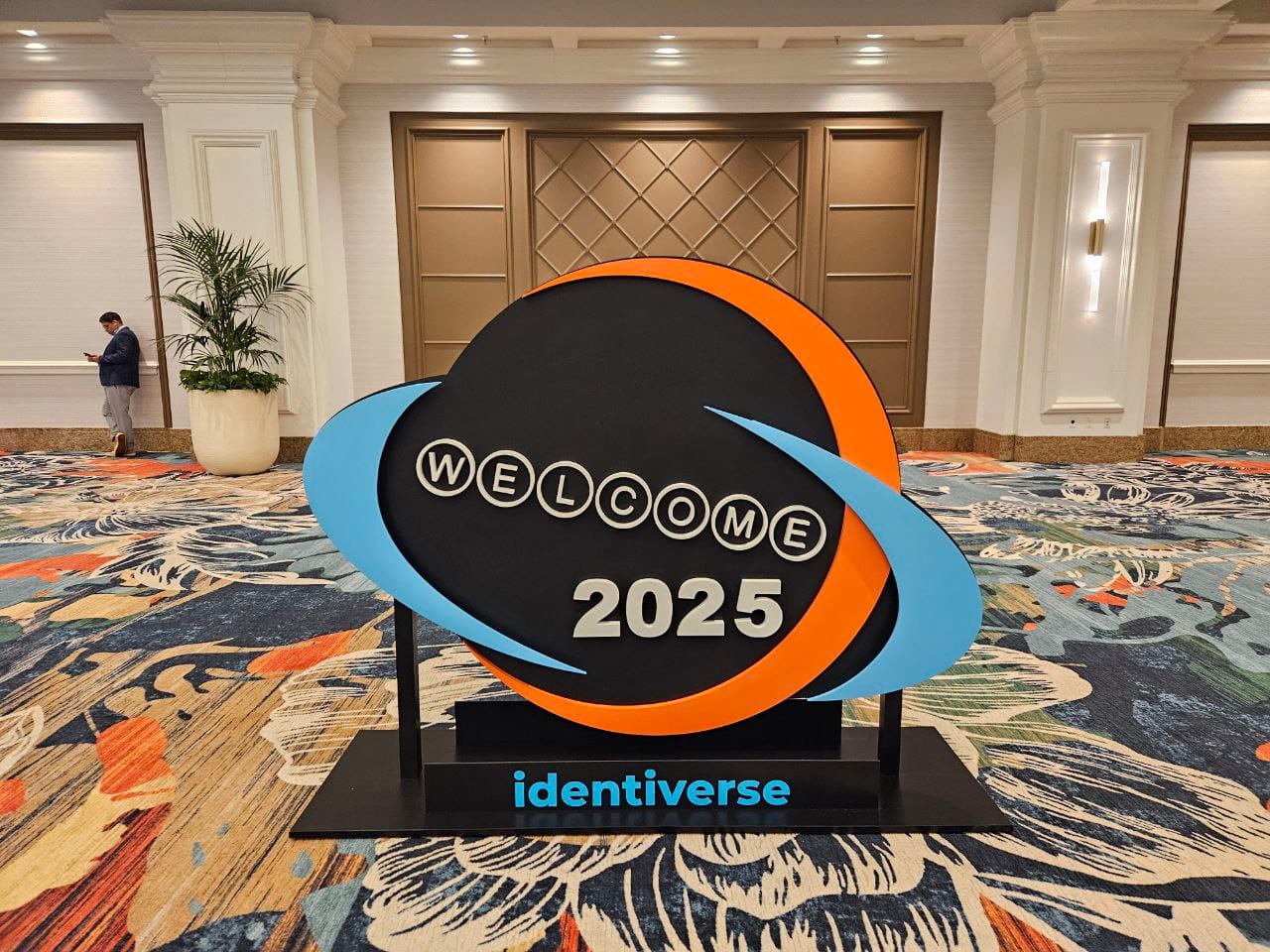
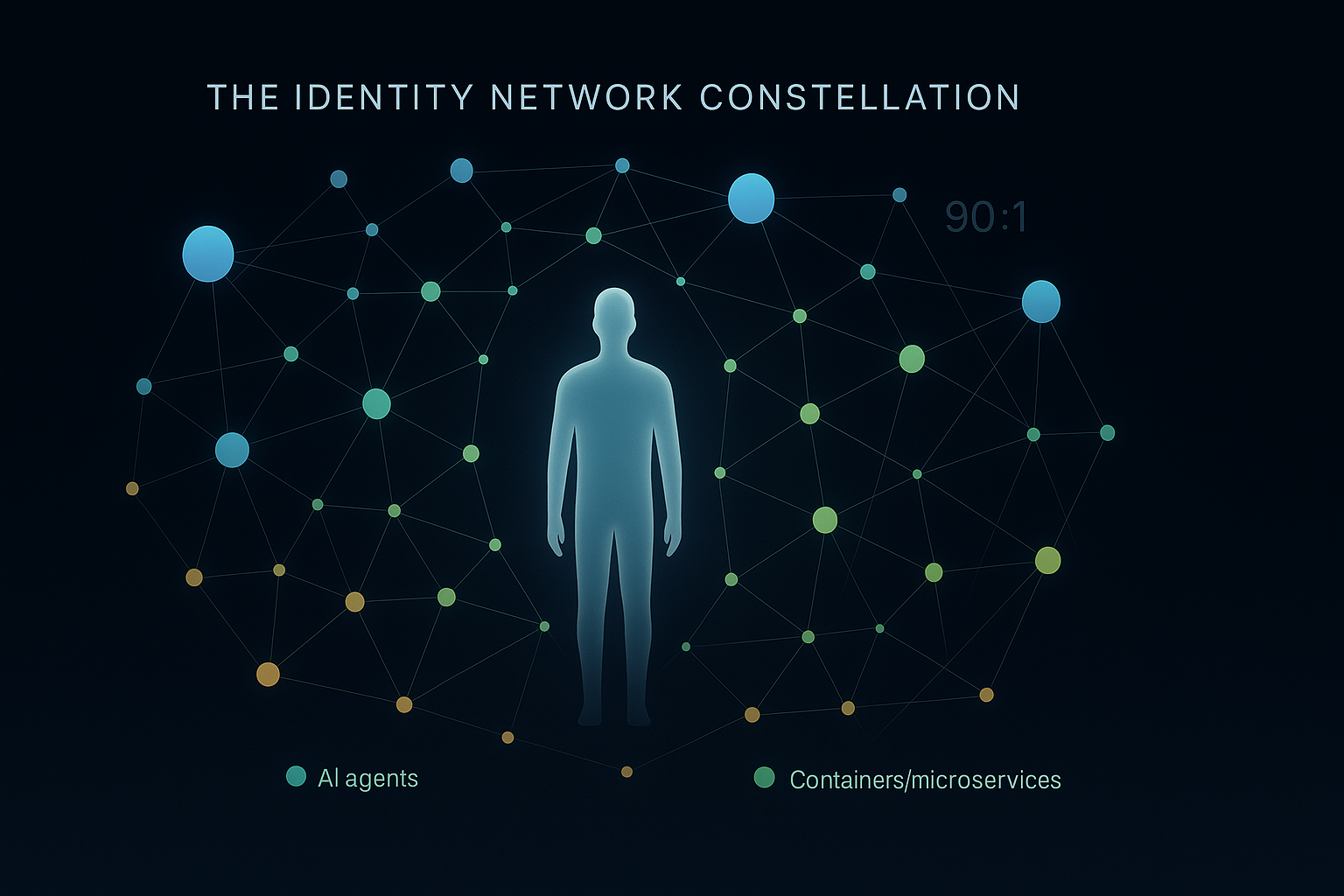
The identity industry stands at its most transformative moment since the advent of digital authentication. At Identiverse 2025 in Las Vegas, over 3,000 cybersecurity professionals witnessed a paradigm shift where non-human identities now outnumber humans by ratios exceeding 90:1, fundamentally reshaping how we think about access, trust, and security in an AI-driven world. This isn't just another technological evolution—it's the emergence of a new digital ecosystem where machines, AI agents, and human identities must coexist securely at unprecedented scale.

The implications are staggering. Organizations are grappling with identity sprawl where 60% manage over 21 identities per user, while AI-powered attacks have surged 3,000% for deepfake fraud and 700% for AI-generated phishing. Yet this same AI technology promises to revolutionize identity management through behavioral analytics, continuous authentication, and predictive threat detection. The industry has reached an inflection point where traditional perimeter-based security models are obsolete, and identity has become the new security perimeter.

From an entrepreneurial perspective, this transformation represents both the greatest opportunity and the most complex challenge the cybersecurity industry has faced. The global identity and access management market is projected to grow from $19.8 billion in 2024 to $61.74 billion by 2032, driven not just by digital transformation but by fundamental changes in how digital entities interact, authenticate, and establish trust.

The rise of non-human identities changes everything

The most striking revelation from Identiverse 2025 was the sheer scale of non-human identity proliferation. NHIs now outnumber human identities by as much as 100:1 in DevOps environments, with service accounts, API keys, workload identities, containers, microservices, and AI agents creating an identity explosion that traditional IAM systems simply weren't designed to handle.

Consider the scope: organizations average 82 machine identities per human employee, yet in cloud-native environments, this ratio reaches 40,000:1. These aren't just static service accounts—they're dynamic, ephemeral identities that spawn and dissolve based on workload demands, creating visibility gaps that attackers are already exploiting. The OWASP Non-Human Identities Top 10 framework, prominently featured at the conference, highlights risks that most security teams are only beginning to understand.

Identity's New Frontier: AI, Machines, and the Future of Digital Trust

The challenge isn't merely about scale—it's about fundamental architectural assumptions. Traditional IAM systems were built around human identity patterns: predictable login times, consistent device usage, and relatively stable role assignments. Non-human identities operate on entirely different principles: they're programmatic, high-frequency, context-dependent, and often ephemeral. A container might exist for minutes, an API key might rotate hourly, and an AI agent might switch between multiple identities within a single transaction.

What makes this particularly complex is that only 5% of NHI permissions are actually used, yet over 50% are classified as high-risk. This represents a massive attack surface expansion where organizations are granting excessive privileges to identities they can barely track, let alone govern effectively. The traditional principle of least privilege becomes exponentially more complex when applied to thousands of machine identities operating at machine speed.

AI transforms identity management with dual-edged complexity

Artificial intelligence's impact on identity management embodies the classic double-edged sword—it's simultaneously the solution to our most pressing security challenges and the source of unprecedented new threats. At Identiverse 2025, sessions like "Who Am I When I'm Not Me? Identity in the Age of AI Agents" captured this paradox perfectly.

On the defensive side, AI is revolutionizing identity security through behavioral biometrics that analyze typing patterns, mouse movements, and interaction behaviors with remarkable precision. Machine learning algorithms can now detect anomalies in user behavior within milliseconds, enabling continuous authentication that adapts to risk in real-time. Organizations implementing AI-driven fraud detection report 74% improvement in accuracy while reducing false positives that traditionally frustrated users.

The power of AI-enhanced identity verification is evident in document authentication, where systems now utilize 35+ proprietary AI models trained on real-world datasets to detect forgeries, morphing attacks, and synthetic documents with unprecedented accuracy. Liveness detection for biometric authentication now exceeds 99% accuracy for enterprise-grade solutions, making sophisticated spoofing attacks significantly more difficult.

However, the offensive capabilities that AI provides to attackers are equally impressive and concerning. The 3,000% increase in deepfake-driven identity fraud represents more than statistical growth—it signals a fundamental shift in the threat landscape. AI-generated synthetic identities, voice cloning for social engineering, and deepfake video calls targeting executives are no longer theoretical risks but operational realities that security teams face daily.

Perhaps most concerning is the emergence of agentic AI systems that can autonomously switch between human and non-human identities, making access decisions without human oversight while potentially being manipulated through prompt injection attacks. These AI agents require new authentication paradigms that traditional OAuth and SAML systems simply cannot provide.

Passwordless authentication reaches enterprise maturity

The passwordless revolution has moved beyond proof-of-concept to enterprise-scale deployment, with 50% of US enterprises now implementing some form of passwordless authentication. Gartner's prediction that 75% of workforce authentication transactions will be passwordless by 2027 is already materializing faster than anticipated, driven by improved user experience and demonstrable security benefits.

The technical foundation is solid: passkeys are enabled on over 90% of iOS and Android devices, and WebAuthn support is universal across major browsers. Organizations like Accenture report 60% reduction in phishing attacks after implementing Windows Hello for Business across all devices, while Discord achieved 100% phishing-resistant authentication for their workforce through mandatory security keys.

From an implementation perspective, the convergence of identity wallets and passkeys represents the most significant authentication advancement since multi-factor authentication. The ability to store credentials securely on devices while maintaining cross-platform synchronization addresses the historical trade-offs between security and convenience. Christine Owen from 1Kosmos noted this convergence as driving "the next wave of passwordless authentication solutions."

The market dynamics support this trend: the global passwordless authentication market grew from $18.82 billion in 2024 to $21.58 billion in 2025, with projections reaching $86.35 billion by 2033. These aren't just aspirational forecasts—they reflect real enterprise spending on technologies that deliver measurable ROI through reduced support costs and improved security posture.

However, implementation challenges remain significant. 67% of organizations face compatibility issues with existing infrastructure, and the initial investment averaging $1 million for large enterprises requires careful ROI planning. The key to successful passwordless adoption lies in phased implementations that start with high-risk user groups and critical applications while maintaining robust fallback mechanisms.

Fraud prevention evolves through intelligent automation

The evolution of fraud prevention in identity management reflects the broader shift toward intelligent, automated security systems that can operate at the speed and scale of modern digital interactions. Traditional rule-based fraud detection systems are being replaced by AI-powered behavioral analytics that continuously learn and adapt to emerging threats.

The statistics are compelling: machine learning algorithms now reduce credit card fraud detection time to milliseconds while achieving 74% improvement in accuracy. The US Treasury's recovery of $4 billion through ML-enhanced fraud prevention demonstrates the real-world impact of these technologies at scale.

What's particularly interesting is the shift toward multi-modal fraud detection that combines traditional identity verification with behavioral analysis, device intelligence, and contextual risk assessment. Modern systems analyze typing patterns, mouse movements, navigation behavior, and even subtle biometric characteristics to create unique identity profiles that are extremely difficult to replicate or steal.

The emergence of synthetic identity detection represents a crucial advancement as criminals increasingly use AI to create entirely fabricated identities rather than stealing existing ones. These sophisticated attacks require equally sophisticated defenses that can analyze document authenticity, cross-reference identity attributes across multiple databases, and identify patterns that indicate artificial identity construction.

However, the arms race continues to escalate. Morphing attacks using AI face-swap technology now pose significant challenges for passport control and high-security applications. Organizations must balance increasingly sophisticated fraud prevention capabilities with user privacy concerns and regulatory compliance requirements across multiple jurisdictions.

Digital identity wallets promise enhanced privacy and control

The digital identity wallet revolution represents perhaps the most user-empowering development in identity management, shifting control from centralized authorities to individuals while maintaining security and privacy. The EU Digital Identity Wallet framework implementation deadline of 2025 is driving global adoption, with 60% of the global population anticipated to use digital wallets by 2026.

The architecture is compelling: self-sovereign identity (SSI) principles combined with blockchain-based credential verification create tamper-resistant records while enabling selective disclosure. Users can prove specific attributes—age, citizenship, professional credentials—without revealing unnecessary personal information. This addresses the fundamental privacy challenge of traditional identity systems that require over-collection of data to function effectively.

The technical implementation involves verifiable credentials (VCs) following W3C standards and decentralized identifiers (DIDs) that eliminate dependencies on central authorities. When combined with zero-knowledge proofs, users can demonstrate identity attributes without revealing the underlying data—proving they're over 21 without disclosing their actual birthdate, for instance.

Real-world adoption is accelerating: 87% of pilot participants express strong interest in comprehensive digital ID wallets, particularly when they provide seamless integration with existing services while enhancing privacy. The TSA's acceptance of digital driver's licenses and state implementations across California, Louisiana, and Arizona demonstrate practical applications that users can experience today.

The enterprise implications are significant. Organizations can implement privacy-by-design identity verification that meets stringent regulatory requirements while reducing data liability. By relying on verifiable credentials rather than collecting and storing personal information, companies can minimize their exposure to data breaches while improving user trust.

Enterprise challenges demand strategic identity architecture

The reality for enterprise organizations is that identity management has evolved from a compliance requirement to a strategic business enabler that directly impacts operational efficiency, security posture, and competitive advantage. The challenge lies in managing this complexity while maintaining security and user experience.

Current enterprise environments are characterized by 60% of organizations managing over 21 identities per user, creating sprawl that traditional governance frameworks cannot effectively manage. When combined with hybrid work environments where 97% of employees use personal devices for work and multi-cloud architectures that span dozens of platforms, the identity governance challenge becomes exponential.

The cost implications are substantial. Modern identity verification systems require initial investments averaging $1 million for large enterprises, with ongoing operational costs including per-transaction processing fees, infrastructure maintenance, and compliance monitoring. However, organizations that implement comprehensive identity governance report significant ROI through reduced security incidents, improved operational efficiency, and enhanced regulatory compliance.

Zero-trust architecture adoption represents the most significant strategic shift, with Gartner predicting 60% of enterprises will embrace zero-trust as a security starting point by 2025. This isn't merely a technology upgrade—it's a fundamental reimagining of security architecture where identity becomes the primary control plane for access decisions.

The implementation challenges are significant: 51% of organizations struggle with outdated technology and technical debt, while 40% lack adequate resources for comprehensive identity programs. Success requires executive sponsorship, cross-functional collaboration, and a phased approach that balances immediate security improvements with long-term architectural vision.

Strategic implications for the digital trust economy

The transformation of identity management represents the emergence of a digital trust economy where identity verification, authentication, and authorization become foundational services that enable everything from AI agent interactions to cross-border commerce. Organizations that successfully navigate this transformation will establish themselves as leaders in digital trust, while those that lag risk significant security exposure and competitive disadvantage.

From a strategic perspective, identity is becoming the new networking layer of the digital economy. Just as TCP/IP enabled the internet's explosive growth by providing reliable packet routing, modern identity systems enable secure, scalable digital interactions between humans, machines, and AI agents. The organizations that master this identity layer will have significant advantages in deploying AI, enabling digital transformation, and creating new business models.

The investment implications are substantial. Venture capital investment in identity startups continues to grow, with private equity showing renewed interest in identity security companies. CyberArk's $1.54 billion acquisition of Venafi and Permira's $1.3 billion investment in BioCatch demonstrate the market's recognition of identity as a critical infrastructure investment.

Regulatory evolution will continue to shape the industry, with AI governance requirements, expanded privacy regulations, and post-quantum cryptography mandates creating both compliance challenges and market opportunities. Organizations that proactively address these requirements will avoid costly retrofits while positioning themselves as trusted partners for regulated industries.

The path forward: building identity-centric security

The future of cybersecurity is identity-centric, and the organizations that recognize this shift earliest will have the greatest advantages. This isn't about implementing another security tool—it's about fundamentally rethinking security architecture around identity as the primary control plane.

Immediate priorities should focus on zero-trust implementation, AI defense integration, passwordless transition, and comprehensive machine identity management. These aren't separate initiatives but interconnected components of a modern identity security fabric that can scale with organizational growth and technological change.

Medium-term strategy requires development of integrated identity platforms that span IAM, PAM, and governance while preparing for decentralized identity systems and quantum-safe cryptography. This architectural foundation will enable organizations to adapt quickly to emerging technologies and regulatory requirements.

Long-term positioning involves preparing for sovereign identity ecosystems, predictive identity security, ambient authentication, and cross-border interoperability. These capabilities will define competitive advantage in the digital economy of the 2030s.

The identity industry's evolution from access control to comprehensive digital trust platforms represents one of the most significant technology shifts of our era. The companies that master identity management will control the foundational layer of digital trust that enables everything from AI deployment to global commerce. The question isn't whether to invest in identity security—it's whether you'll lead this transformation or be forced to follow.

The age of identity-centric security has arrived. The organizations that embrace this shift will thrive in an AI-powered, machine-abundant digital future. Those that cling to perimeter-based security models will find themselves increasingly vulnerable in a world where the perimeter has dissolved and identity is everything.

https://bit.ly/45mduyB
https://bit.ly/43UPqAw


https://2.gravatar.com/avatar/b7ed20e10da488de193e75b40fa28ba5ceda96c4265525794861ddaa33ae7723?s=96&d=identicon&r=G
https://deepakguptaplus.wordpress.com/2025/06/10/identitys-new-frontier-ai-machines-and-the-future-of-digital-trust/

Tuesday, June 3, 2025

Growth Hacking 2.0: From Traditional SEO to AI-Powered Answer Engine Optimization

The Evolution of Digital Growth Strategies in the Age of AI

Growth Hacking 2.0: From Traditional SEO to AI-Powered Answer Engine Optimization

As someone who has built and scaled multiple tech companies over the past decade, I've witnessed firsthand the dramatic transformation of growth hacking strategies. What began as clever workarounds and viral loops has evolved into sophisticated, AI-powered systems that fundamentally change how B2B SaaS companies approach digital growth.

Today, we stand at another pivotal moment: the shift from Search Engine Optimization (SEO) to Answer Engine Optimization (AEO).

The Genesis of Growth Hacking: A Look Back 10-15 Years Ago

The Birth of a Movement (2010-2015)

Growth hacking emerged in the early 2010s when startups needed to compete with established companies despite limited resources. The term, coined by Sean Ellis in 2010, described a new breed of marketers who combined technical skills with creative thinking to achieve exponential growth.

During this era, growth hacking was characterized by several key strategies:

The Viral Loop Era: Companies like Dropbox revolutionized user acquisition by offering additional storage space for referrals. This simple mechanism turned every user into a potential advocate, creating exponential growth without traditional advertising spend.

Email Harvesting and Cold Outreach: Early growth hackers would scrape LinkedIn profiles, use tools like Rapportive to find email addresses, and send highly personalized cold emails at scale. While effective, these tactics often walked a fine line between clever and invasive.

Content Marketing at Scale: Companies discovered they could dominate search results by producing massive amounts of content targeting long-tail keywords. HubSpot's blog became the blueprint, publishing multiple articles daily to capture search traffic.

The Freemium Revolution: B2B SaaS companies began offering free tiers to reduce customer acquisition costs. This wasn't just about pricing; it was about removing friction from the buying process entirely.

The Technical Foundation

What made these early growth hackers unique was their technical capability. They weren't just marketers; they were engineers who could:

  • Write scripts to automate repetitive tasks
  • Build custom tracking systems to measure micro-conversions
  • Create A/B testing frameworks before tools like Optimizely became mainstream
  • Reverse-engineer competitor strategies through technical analysis

Remember spending nights writing scripts to analyze competitor backlinks, automate social media posting, and track user behavior patterns. The technical barrier to entry was high, but the rewards for those who could bridge marketing and engineering were substantial.

The Transformation: How AI Changed Everything

The AI Revolution in Growth (2018-2024)

The introduction of accessible AI tools marked a fundamental shift in growth hacking. What once required teams of engineers could now be accomplished with AI-powered platforms. This democratization changed the competitive landscape entirely.

Predictive Analytics Becomes Accessible: Machine learning models that once required data science teams became available through user-friendly interfaces. Suddenly, predicting customer churn, identifying upsell opportunities, and optimizing pricing became possible for companies of all sizes.

Content Generation at Unprecedented Scale: AI writing tools transformed content marketing. Where teams once struggled to produce a few articles per week, AI could generate hundreds of pieces of content, each optimized for specific keywords and user intents.

Hyper-Personalization: AI enabled personalization that went beyond "Hi {FirstName}." Systems could now analyze user behavior patterns, predict preferences, and deliver truly individualized experiences across every touchpoint.

Automated Optimization: AI systems began optimizing campaigns in real-time, adjusting bidding strategies, testing creative variations, and reallocating budgets faster than any human team could manage.

The Dark Side of AI-Powered Growth

However, this AI revolution also created new challenges:

  • Content Saturation: The ease of content creation led to an explosion of low-quality, AI-generated articles flooding the internet
  • Diminishing Returns: As everyone adopted similar AI tools, competitive advantages eroded
  • User Fatigue: Consumers became increasingly skeptical of obviously AI-generated content and interactions
  • Platform Responses: Search engines and social platforms began updating algorithms to combat AI manipulation

The Paradigm Shift: From SEO to Answer Engine Optimization (AEO)

Understanding the Fundamental Change

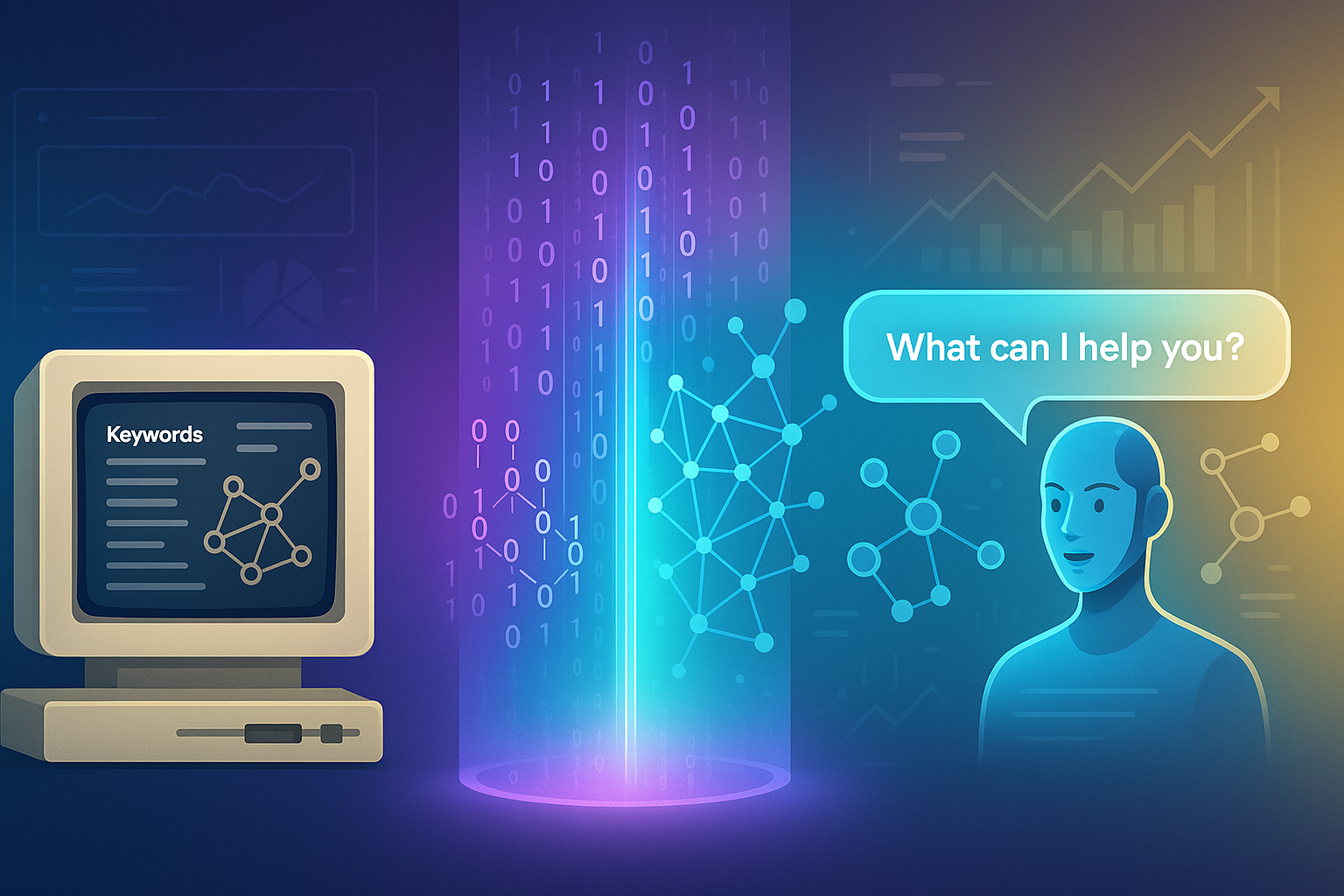
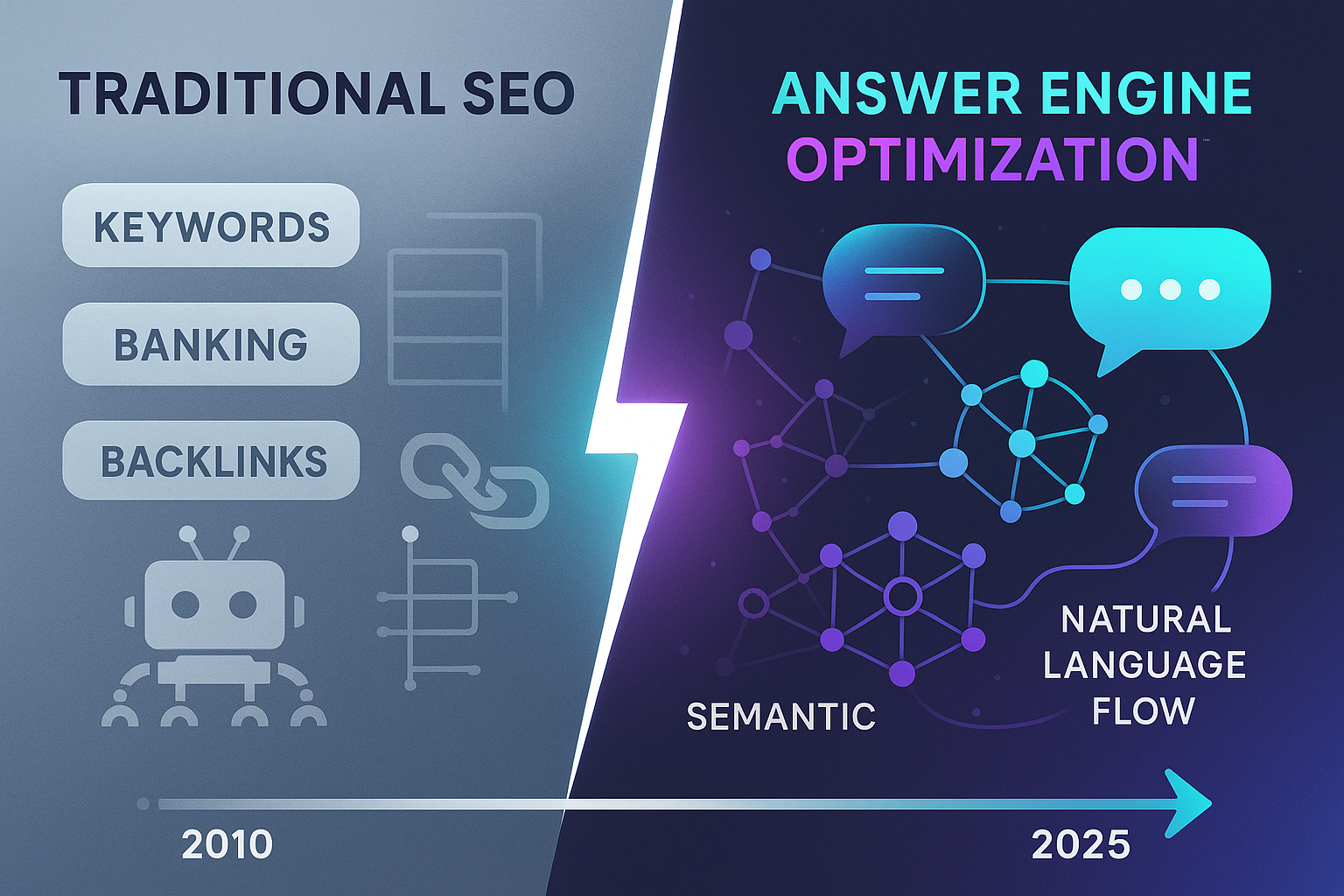
The launch of Google's AI-powered search experience and the rise of conversational AI assistants represent more than just new features—they signal a fundamental shift in how people seek and consume information. Traditional SEO optimized for keywords and rankings; AEO optimizes for direct answers and conversational understanding.

This shift is driven by several factors:

User Behavior Evolution: Modern users don't want to click through multiple links to find answers. They want immediate, accurate responses to their queries. This behavior, accelerated by voice search and mobile usage, demands a new optimization approach.

AI's Semantic Understanding: Unlike traditional search algorithms that relied heavily on keywords, AI systems understand context, intent, and nuance. They can interpret questions, understand follow-ups, and provide comprehensive answers drawn from multiple sources.

The Zero-Click Reality: Google's AI mode often provides complete answers without requiring users to visit websites. This creates both challenges and opportunities for B2B SaaS companies seeking visibility.

Traditional SEO vs. AEO: A Detailed Comparison

To understand the magnitude of this shift, let's examine the key differences:

Growth Hacking 2.0: From Traditional SEO to AI-Powered Answer Engine Optimization

Traditional SEO focused on:

  • Keyword density and placement
  • Backlink quantity and domain authority
  • Page load speed and technical optimization
  • Meta descriptions and title tags
  • Creating content for search crawlers

Answer Engine Optimization focuses on:

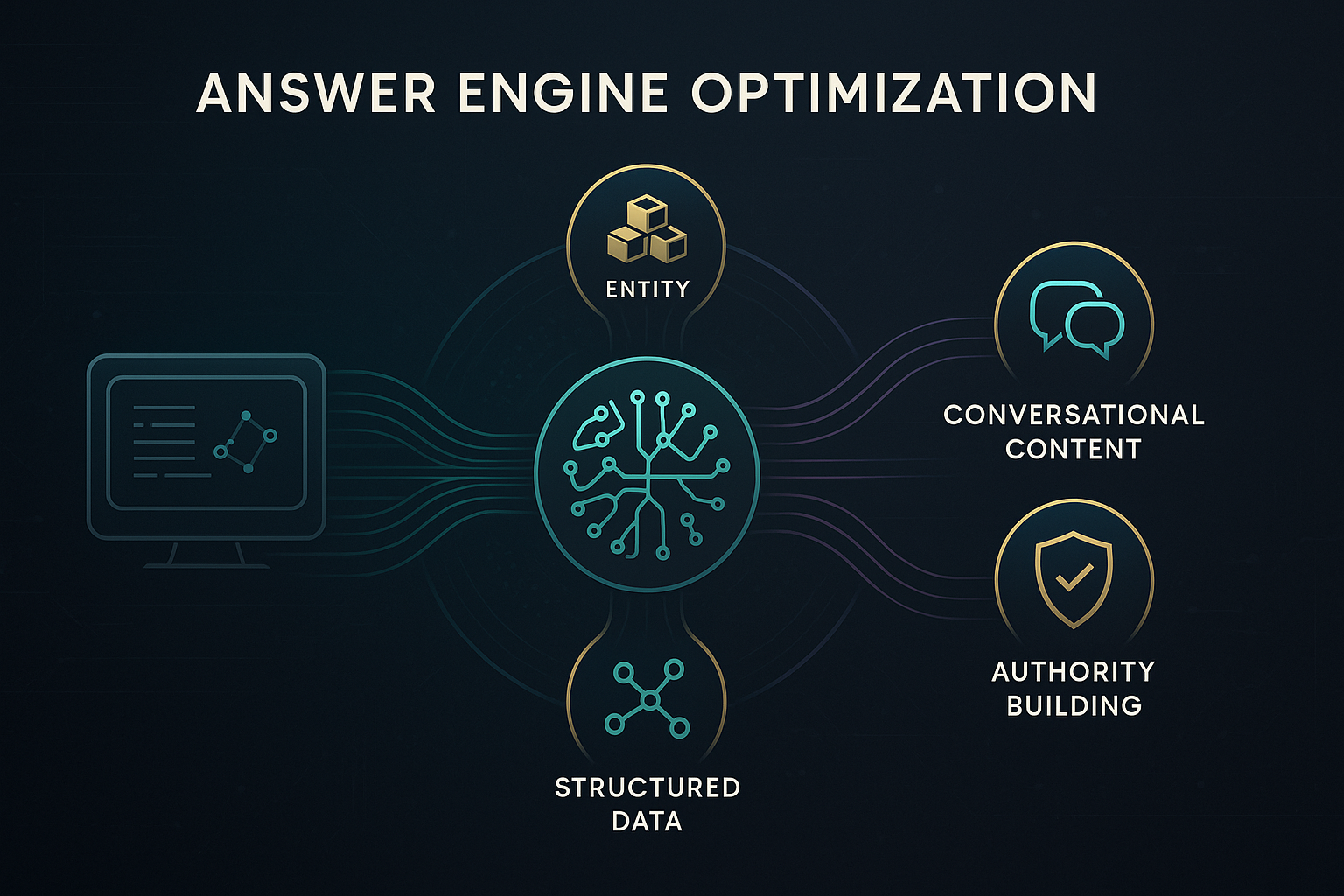
  • Comprehensive, authoritative answers
  • Semantic relevance and topic clustering
  • Conversational content structure
  • Entity relationships and knowledge graphs
  • Creating content for AI comprehension

The shift from SEO to AEO isn't just about tactics—it's about mindset. Where SEO asked "How can I rank for this keyword?", AEO asks "How can I provide the most valuable answer to this question?"

Key Strategies for B2B SaaS AEO Success

1. Entity-Based Content Architecture

AI systems think in terms of entities and relationships. For B2B SaaS companies, this means structuring content around:

Core Entity Definition: Clearly define what your product is, what problems it solves, and how it relates to other tools in your ecosystem. Create comprehensive "entity pages" that serve as authoritative sources about your product and its capabilities.

Relationship Mapping: Document how your solution connects to broader industry concepts, complementary tools, and use cases. AI systems use these relationships to understand context and recommend solutions.

Technical Documentation as AEO Assets: Transform your technical documentation into question-answer formats. Instead of traditional docs, create content that directly addresses "How do I…" and "What happens when…" queries.

2. Conversational Content Optimization

AI systems favor content that mirrors natural conversation:

Question-First Structure: Begin sections with the exact questions your prospects ask. Follow with comprehensive, nuanced answers that address multiple perspectives.

Progressive Disclosure: Structure content to provide immediate answers while offering deeper dives for those seeking more detail. This satisfies both quick-answer seekers and thorough researchers.

Natural Language Patterns: Write as you would explain concepts to a colleague. Avoid keyword stuffing or unnatural phrasing that traditional SEO might have encouraged.

3. Authority Through Comprehensive Coverage

AEO rewards depth and breadth of coverage:

Topic Cluster Strategy: Create interconnected content ecosystems around core topics. Each piece should contribute to a comprehensive understanding of your domain.

Multi-Perspective Analysis: Address topics from various angles—technical implementation, business impact, cost considerations, and competitive comparisons. AI systems synthesize these perspectives to provide balanced answers.

Living Documentation: Regularly update content to reflect industry changes. AI systems favor current, actively maintained information sources.

4. Structured Data and Knowledge Graphs

Help AI systems understand your content:

Schema Markup Evolution: Go beyond basic schema to include FAQ, HowTo, and SoftwareApplication markups. These help AI systems extract and present your information effectively.

Internal Knowledge Graphs: Build explicit connections between your content pieces. Use consistent terminology and cross-referencing to reinforce entity relationships.

API Documentation for AI: Consider how AI systems might programmatically access your information. Well-structured APIs and documentation become AEO assets.

5. User Intent Optimization

Understanding and addressing user intent becomes even more critical:

Intent Mapping: Identify the various intents behind queries related to your product:

  • Informational: "What is customer identity management?"
  • Navigational: "Product documentation"
  • Commercial: "Best CIAM solutions for enterprises"
  • Transactional: "Product pricing"

Intent-Specific Content: Create distinct content types for each intent, ensuring comprehensive coverage across the buyer journey.

Contextual Answers: Provide answers that acknowledge the user's likely situation and next steps. AI systems value content that anticipates follow-up questions.

Advanced AEO Tactics for B2B SaaS

Growth Hacking 2.0: From Traditional SEO to AI-Powered Answer Engine Optimization

1. Competitive Intelligence Through AEO

Monitor how AI systems present your competitors:

Answer Analysis: Regularly query AI systems about your product category. Analyze which companies and solutions are mentioned, and why.

Gap Identification: Find questions where your competitors appear but you don't. These represent immediate optimization opportunities.

Narrative Shaping: Create content that positions your unique value propositions in ways AI systems will recognize and relay.

2. Technical SEO Evolved for AEO

Technical optimization takes new forms:

Crawlability for AI: Ensure your content is easily parseable by AI systems. This includes clean HTML structure, logical content hierarchy, and accessible text.

Performance for Processing: While page speed remains important, focus on how quickly AI can extract meaning from your content. Minimize JavaScript-rendered content that might impede AI comprehension.

Multi-Format Optimization: Provide content in various formats—text, structured data, and even audio transcripts—to maximize AI accessibility.

3. Building AEO-Friendly Product Features

Your product itself becomes an AEO asset:

In-Product Content: Feature descriptions, help text, and error messages contribute to your AEO profile. Ensure they're comprehensive and searchable.

Public-Facing APIs: Well-documented APIs help AI systems understand your product's capabilities and integration possibilities.

User-Generated Content: Customer reviews, community discussions, and support forums provide authentic signals that AI systems value.

Measuring AEO Success

Traditional SEO metrics don't fully capture AEO performance:

New Metrics for the AEO Era

Answer Appearance Rate: How often your content appears in AI-generated responses for relevant queries.

Sentiment in AI Responses: Not just whether you're mentioned, but how positively and prominently.

Conversational Share of Voice: Your presence in multi-turn AI conversations about your category.

Intent Coverage Score: The percentage of user intents in your domain where your content provides answers.

Tools and Techniques for AEO Measurement

AI Query Testing: Regularly test how various AI systems respond to queries about your domain. Document changes over time.

Semantic Search Analytics: Use tools that analyze semantic relationships and topic coverage rather than just keyword rankings.

User Journey Tracking: Monitor how users move from AI-provided answers to your properties, even without direct clicks.

How GrackerAI is Pioneering Next-Gen AEO for B2B SaaS

At GrackerAI, we recognized early that the shift to AEO would require entirely new approaches and tools. Traditional SEO platforms weren't designed for a world where AI systems mediate between users and information. That's why we built the world's first AI-powered Search Engine Marketing Agent specifically for B2B SaaS companies.

Our Approach to AEO

AI-Native Architecture: Unlike tools that bolt AI onto existing SEO frameworks, GrackerAI was built from the ground up for the AEO era. Our system understands how AI assistants process and present information, optimizing your content accordingly.

Semantic Intelligence Engine: We go beyond keywords to understand the semantic relationships within your content ecosystem. Our platform identifies gaps in your topic coverage and suggests content that strengthens your authority in AI systems' understanding.

Conversational Optimization: GrackerAI analyzes how AI systems discuss your product category and automatically suggests optimizations to improve your presence in these conversations. We help you speak the language that AI systems understand and relay.

Real-Time AEO Monitoring: Our platform continuously monitors how AI systems present your brand versus competitors, alerting you to changes and opportunities in real-time.

Integrated Implementation: We don't just provide insights—our platform integrates with your content management systems to implement AEO optimizations automatically, from schema markup to content structure improvements.

The GrackerAI Advantage

What sets us apart is our deep understanding of both B2B SaaS dynamics and AI behavior:

Industry-Specific Intelligence: We've trained our systems on thousands of B2B SaaS customer journeys, understanding the unique intents and questions in this space.

Competitive Intelligence Automation: Our platform automatically tracks how AI systems position your competitors, identifying opportunities to differentiate your narrative.

ROI-Focused Optimization: We prioritize AEO improvements that drive actual business results—qualified leads, trial signups, and revenue—not just AI mentions.

Continuous Learning: As AI systems evolve, so does GrackerAI. Our platform adapts to changes in how AI assistants process and present information, keeping your optimization strategies current.

The Future of Growth Hacking: Predictions and Preparations

As we look ahead, several trends will shape the evolution of growth hacking and AEO:

1. Hyper-Personalized AI Experiences

AI systems will increasingly tailor responses based on user context, history, and preferences. Growth strategies must account for this variability, creating content that performs well across different personalization scenarios.

2. Multi-Modal Optimization

As AI systems integrate voice, visual, and text inputs, optimization strategies must expand beyond written content. Consider how your brand appears in image recognition, voice responses, and even AI-generated visualizations.

3. Ethical AEO

As AI's influence on information discovery grows, ethical considerations become paramount. Transparent, accurate, and helpful content will be rewarded, while manipulative tactics will face increasing penalties.

4. Integration with AI Workflows

B2B buyers will increasingly use AI assistants throughout their workflow. Growth strategies must consider how to maintain presence and value across these AI-mediated interactions.

Conclusion: Embracing the AEO Revolution

The shift from traditional SEO to Answer Engine Optimization represents more than a tactical change—it's a fundamental reimagining of how B2B SaaS companies connect with potential customers. Where growth hacking once meant finding clever shortcuts, it now means building genuine authority that AI systems recognize and relay.

Success in this new era requires:

  • Deep understanding of your domain and audience
  • Commitment to creating genuinely helpful content
  • Technical sophistication to optimize for AI comprehension
  • Continuous adaptation as AI systems evolve
  • Tools designed specifically for the AEO challenge

At GrackerAI, we're excited to be at the forefront of this transformation, helping B2B SaaS companies navigate the shift from SEO to AEO. The companies that embrace this change early—those that optimize for AI-mediated discovery—will have a significant competitive advantage in the years ahead.

The future of growth hacking isn't about gaming algorithms or finding loopholes. It's about building genuine expertise and authority that AI systems recognize and users value. Welcome to Growth Hacking 2.0—where intelligence meets intelligence, and the best answers win.

https://bit.ly/3Ze3K5D
https://bit.ly/43I0y3h


https://2.gravatar.com/avatar/b7ed20e10da488de193e75b40fa28ba5ceda96c4265525794861ddaa33ae7723?s=96&d=identicon&r=G
https://deepakguptaplus.wordpress.com/2025/06/03/growth-hacking-2-0-from-traditional-seo-to-ai-powered-answer-engine-optimization/

Wednesday, May 28, 2025

The Evolution of Software Development: From Machine Code to AI Orchestration

The Evolution of Software Development: From Machine Code to AI Orchestration

The landscape of software development has undergone a profound transformation over the past three decades. What began as an intricate dance with machine code has evolved into a sophisticated symphony where developers conduct AI-powered orchestras. As someone who's witnessed this evolution firsthand—from writing my first lines of code in a small room in India to building companies that serve millions—I've seen how each paradigm shift has fundamentally altered not just how we write software, but what it means to be a developer.

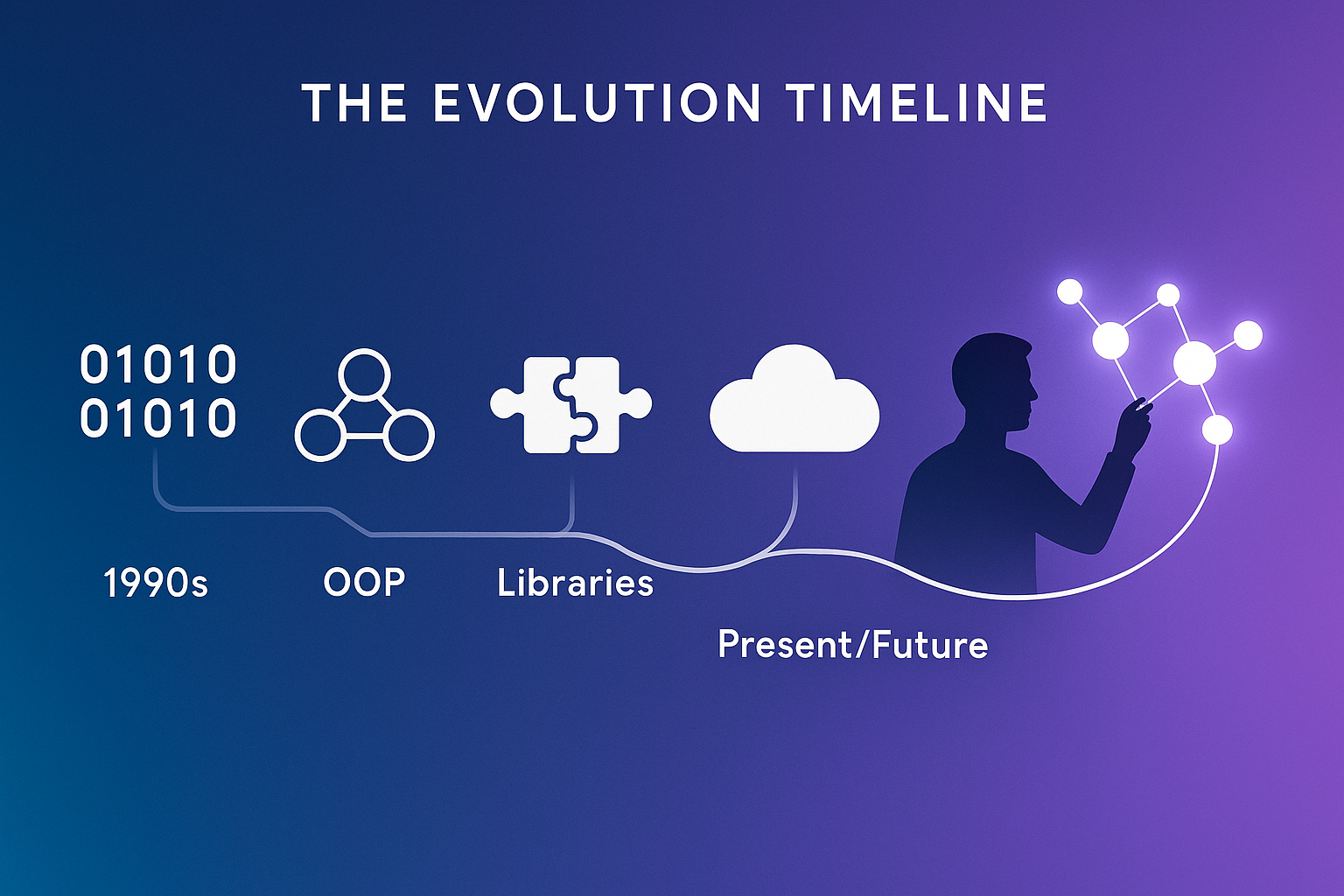
The Foundation Years: Low-Level Programming (1990s)

In the early 1990s, software development was an exercise in precision and patience. Developers worked intimately with hardware, writing in assembly language or C, where every byte mattered and every CPU cycle counted. I remember spending countless hours optimizing memory allocation and managing pointers—tasks that today's developers rarely encounter.

During this era, creating even simple applications required deep understanding of computer architecture. A basic text editor might take weeks to develop, with developers manually handling memory management, file I/O operations, and screen rendering. The relationship between developer and machine was direct and unmediated—you spoke the computer's language, or you didn't speak at all.

The Object-Oriented Revolution (Late 1990s – Early 2000s)

The widespread adoption of object-oriented programming languages like Java and C++ marked the first major abstraction leap. Suddenly, developers could think in terms of objects and behaviors rather than memory addresses and registers. This shift wasn't just technical—it was conceptual.

Object-oriented programming introduced concepts like encapsulation, inheritance, and polymorphism, allowing developers to create more complex systems by building on existing components. The famous "write once, run anywhere" promise of Java epitomized this era's ambition to abstract away hardware specifics. During my early ventures, this paradigm shift allowed us to build more sophisticated applications with smaller teams.

The Age of Frameworks and Libraries (2000s – 2010s)

The next evolution came with the proliferation of frameworks and libraries. Why write a sorting algorithm when you could import one? Why build a web server from scratch when frameworks like Ruby on Rails or Django could scaffold entire applications in minutes?

This period saw an explosion in open-source contributions. Platforms like GitHub transformed how developers collaborated, turning coding from a solitary activity into a global community effort. I leveraged dozens of open-source libraries to accelerate our development in my products, allowing us to focus on our core value proposition rather than reinventing fundamental components.

The rise of package managers—npm for JavaScript, pip for Python, gems for Ruby—made dependency management trivial. A single command could import years of collective developer wisdom into your project. This democratization of code reuse fundamentally changed the economics of software development.

The Cloud and API Era (2010s)

Cloud computing and the API economy introduced another abstraction layer. Developers no longer needed to manage servers or worry about scaling infrastructure. Services like AWS, Google Cloud, and Azure turned infrastructure into code, while thousands of APIs provided ready-made functionality for everything from payment processing to machine learning.

This shift enabled the rise of microservices architecture, where complex applications became collections of specialized, interconnected services. The developer's role evolved from building monolithic applications to orchestrating distributed systems. During this period, we transformed our architecture to leverage cloud services, enabling us to scale globally while maintaining a lean infrastructure team.

The AI Revolution: From Writing to Conducting (2020s – Present)

Today, we're witnessing perhaps the most profound transformation yet. As the statistics reveal, major tech companies are already generating 25-30% of their code through AI. At my current ventures, GrackerAI and LogicBalls, we're experiencing this shift firsthand—AI isn't just a tool; it's becoming a collaborator.

The modern developer increasingly acts as a conductor rather than a performer. Instead of writing every function, we're learning to articulate intentions clearly to AI systems, review generated code for quality and security, and make architectural decisions that guide AI implementation. Tools like GitHub Copilot, GPT-4, and specialized coding agents can generate entire modules based on natural language descriptions.

This transformation is happening faster than many realize. What took weeks to develop five years ago can now be prototyped in hours. The bottleneck is shifting from implementation to ideation and quality assurance.

The Imminent Future: Democratized Development (2025-2030)

Looking ahead, the next three to five years promise even more dramatic changes. We're approaching a inflection point where the barrier to creating software will be primarily conceptual rather than technical. Anyone with a clear idea and basic understanding of logic will be able to build functional applications.

This democratization doesn't diminish the role of professional developers—it elevates it. As AI handles routine coding tasks, developers will focus on:

Architecture and System Design: Creating robust, scalable architectures that can evolve with changing requirements. AI can write code, but it cannot yet design complex distributed systems or make nuanced trade-offs between performance, cost, and maintainability.

Security and Compliance: As more code is AI-generated, ensuring security becomes paramount. Developers will need to audit AI-generated code for vulnerabilities, implement security best practices, and ensure compliance with increasingly complex regulations.

Performance Optimization: While AI can generate functional code, optimizing for specific use cases, reducing latency, and improving resource utilization will remain human domains where experience and intuition matter.

Business Logic and Domain Expertise: Understanding the nuanced requirements of specific industries and translating them into technical specifications will become the developer's primary value proposition.

The New Developer Paradigm

The future software engineer will be less like a craftsperson meticulously carving code and more like an architect designing blueprints, a conductor orchestrating various AI agents, and a quality assurance expert ensuring everything meets standards. This shift represents not a diminishment but an evolution of the role.

Consider the progression: We've moved from telling computers exactly how to do something (imperative programming) to describing what we want (declarative programming) to simply explaining our goals in natural language (AI-assisted programming). Each abstraction layer has allowed developers to solve more complex problems with less effort.

Quality in the Age of AI

While AI will democratize basic software creation, professional developers will differentiate themselves through:

Holistic Thinking: Understanding how individual components fit into larger systems, considering edge cases, and anticipating future needs.

Quality Assurance: Ensuring code is not just functional but maintainable, efficient, and secure. AI might generate code that works, but does it work well? Is it testable? Is it documented?

Innovation: While AI excels at pattern matching and applying known solutions, true innovation—creating entirely new paradigms or solving novel problems—remains a human strength.

Ethical Considerations: As software increasingly impacts society, developers must consider ethical implications, bias in AI systems, and the broader consequences of their creations.

Embracing the Transformation

This evolution isn't something to fear but to embrace. Just as the shift from assembly to high-level languages didn't eliminate programmers but enabled them to build more ambitious projects, the AI revolution will amplify human creativity rather than replace it.

At LogicBalls, we're working to ensure this future is accessible to everyone, not just those with traditional programming backgrounds. The goal isn't to replace developers but to expand who can participate in software creation while elevating the role of professional developers to focus on higher-value activities.

The Road Ahead

The transformation of software development over the past 30 years has been remarkable, but the next decade promises even more dramatic changes. We're moving from an era where coding was a specialized skill to one where it becomes a form of enhanced communication with intelligent systems.

For current and aspiring developers, the message is clear: embrace the abstraction, focus on understanding systems rather than syntax, and develop skills in architecture, security, and human-AI collaboration. The future belongs not to those who can write the most code, but to those who can envision, orchestrate, and ensure the quality of complex systems.

As someone who started their journey debugging code through sleepless nights, I find this evolution both humbling and exciting. We're not just writing software anymore—we're conducting symphonies of human creativity and artificial intelligence, creating possibilities we couldn't have imagined just a few years ago.

The future of software development isn't about humans versus AI; it's about humans with AI, creating a world where anyone can transform their ideas into reality while professional developers ensure that reality is secure, scalable, and sustainable. This is the future we're building, one abstraction layer at a time.

https://ift.tt/MnQ6Khf
https://ift.tt/BuCXLTf


https://2.gravatar.com/avatar/b7ed20e10da488de193e75b40fa28ba5ceda96c4265525794861ddaa33ae7723?s=96&d=identicon&r=G
https://deepakguptaplus.wordpress.com/2025/05/28/the-evolution-of-software-development-from-machine-code-to-ai-orchestration/

Monday, May 26, 2025

Unlocking the Gates: REST API Authentication Methods for Modern Security

Unlocking the Gates: REST API Authentication Methods for Modern Security

Securing your API endpoints isn't just good practice—it's essential survival. As cyber threats grow increasingly sophisticated, understanding the authentication mechanisms that protect your digital assets becomes a critical skill for developers and architects alike.

Having built authentication systems that protect millions of user accounts, I've seen firsthand how proper authentication can make or break an application's security posture. Let's dive into the four fundamental REST API authentication methods every developer should master.

Why API Authentication Matters

Before we explore specific methods, let's understand what's at stake. REST APIs serve as the connective tissue of modern applications, enabling everything from mobile apps to IoT devices to access your systems. Without robust authentication:

  • Unauthorized users could access sensitive data
  • Attackers could manipulate your systems through API calls
  • Your infrastructure could be vulnerable to abuse and rate-limiting bypasses
  • Compliance requirements (GDPR, HIPAA, etc.) would be impossible to meet

Now, let's unlock the secrets of four essential authentication methods.

๐Ÿงพ Basic Authentication: The Digital Equivalent of an ID Card

How It Works

Basic Authentication is exactly what it sounds like—basic. It involves transmitting a username and password with each request, encoded in base64 format, typically in the Authorization header:

Authorization: Basic dXNlcm5hbWU6cGFzc3dvcmQ=

The server decodes this string, separates the username and password, and verifies them against stored credentials.

Security Considerations

Here's where things get critical: base64 encoding is not encryption. It's merely encoding that can be easily reversed. This means Basic Authentication must always be used with HTTPS/TLS to prevent credential interception.

When to Use Basic Authentication

  • Internal applications within secure networks
  • Development environments
  • Simple systems where implementation simplicity outweighs security concerns
  • When paired with additional security layers (IP restrictions, VPNs)

When to Avoid It

  • Public-facing APIs
  • Mobile applications (storing credentials securely is challenging)
  • High-security environments
  • Any scenario where passwords might be intercepted

๐Ÿ”‘ Token-Based Authentication (JWT): The Digital Passport

How It Works

JWT (JSON Web Token) authentication addresses many limitations of Basic Authentication by creating a signed token that confirms a user's identity without repeatedly transmitting credentials.

The process works in three steps:

  1. Authentication: User provides credentials once
  2. Token Generation: Server validates credentials and issues a signed JWT
  3. Authorization: Subsequent requests include the JWT instead of credentials

A JWT consists of three parts:

  • Header: Contains token type and signing algorithm
  • Payload: Contains claims (user ID, permissions, expiration)
  • Signature: Verifies the token hasn't been tampered with

Security Advantages

  • Credentials are transmitted only once
  • Tokens can be scoped to specific permissions
  • Tokens have expiration times, limiting damage from theft
  • Stateless design improves scalability

Implementation Best Practices

  • Set appropriate expiration times (balance security vs. user experience)
  • Use refresh tokens for longer sessions
  • Store tokens securely (HttpOnly cookies or secure local storage)
  • Implement token revocation mechanisms for compromised tokens
  • Never store sensitive data in the payload (it's encoded, not encrypted)

When to Use JWT

  • Single page applications (SPAs)
  • Mobile applications
  • Microservices architectures
  • When you need stateless authentication
  • Cross-domain authentication scenarios

๐Ÿ›ก️ OAuth 2.0: The Delegation Framework

How It Works

OAuth 2.0 isn't just an authentication method—it's a framework for authorized access. It enables third-party applications to access resources without exposing user credentials.

The core concept is delegation: users authorize applications to act on their behalf with limited scope.

Key OAuth Flows

Authorization Code Flow:

  1. User initiates login through third-party app
  2. User is redirected to authorization server
  3. User consents to specific permissions (scopes)
  4. Authorization server returns code to application
  5. Application exchanges code for access token
  6. Application uses token to access resources

Client Credentials Flow: Used for server-to-server communication where user consent isn't needed.

Implicit Flow: Simplified flow for browser-based applications (though less recommended now).

Resource Owner Password Credentials Flow: Allows direct credential exchange (used sparingly due to security concerns).

Security Considerations

  • Implement proper redirect URI validation
  • Use PKCE (Proof Key for Code Exchange) for public clients
  • Enforce limited token scopes
  • Implement proper token validation
  • Set appropriate token lifetimes

When to Use OAuth 2.0

  • Third-party integrations
  • Social login features
  • API ecosystem development
  • Granular permission systems
  • When you need user consent workflows

๐Ÿ“ฌ API Key Authentication: The Simple Access Pass

How It Works

API keys are long, generated strings provided to developers or services that want to access your API. They're typically included in headers, query parameters, or sometimes in the request body:

Authorization: ApiKey your_api_key_here
X-API-Key: your_api_key_here

Implementation Approaches

  • Header-based: Most secure, less exposed
  • Query Parameter: Easier for simple integrations but visible in logs
  • Mixed Authentication: Combining API keys with other methods for layered security

Security Considerations

  • API keys typically don't expire automatically
  • They're often shared across an entire application (lack of user-specific context)
  • If compromised, they provide full access until revoked
  • Key rotation mechanisms are essential

When to Use API Keys

  • Public APIs with rate limiting needs
  • Developer-focused services
  • Internal service-to-service communication
  • When simplicity of implementation is paramount
  • For services where user context isn't necessary

Choosing the Right Authentication Method

The right authentication approach depends on your specific requirements. Here's a comparative framework:

Factor Basic Auth JWT OAuth 2.0 API Keys
Implementation Complexity Low Medium High Low
Security Level Low (without HTTPS) Medium-High High Medium
User Experience Poor (frequent logins) Good Good N/A (backend)
Scalability Poor Excellent Good Good
Revocation Difficult Challenging Easy Moderate
Best For Simple internal apps Modern web/mobile apps Delegated access Service-to-service

Beyond Authentication: Comprehensive API Security

Authentication is just one layer of API security. For truly robust protection:

  1. Implement Authorization: Authentication verifies identity; authorization controls what authenticated users can do
  2. Use Rate Limiting: Prevent abuse with request quantity restrictions
  3. Validate All Inputs: Prevent injection attacks
  4. Monitor and Log: Track suspicious activities and maintain audit trails
  5. Keep Dependencies Updated: Address vulnerabilities in your authentication libraries
  6. Use HTTPS Everywhere: Encrypt all API traffic
  7. Consider API Gateways: Centralize authentication and security policies

The Future of API Authentication

The authentication landscape continues to evolve. Watch for these emerging trends:

  • Passwordless Authentication: Biometrics, magic links, and other alternatives
  • Zero Trust Architecture: Never trust, always verify
  • Continuous Authentication: Risk-based assessment beyond the initial authentication
  • Decentralized Identity: Blockchain-based solutions that put users in control

Final Thoughts

API authentication isn't just about keeping bad actors out—it's about building trust with partners, customers, and other stakeholders who rely on your services. The method you choose sends a message about how seriously you take security.

In my experience building identity solutions at scale, the most successful approaches balance security with usability. Overly complex security measures often lead to workarounds that create vulnerabilities, while overly simple solutions leave your systems exposed.

Whether you're building a public API for thousands of developers or securing internal microservices, start with a clear understanding of your threat model, user needs, and development resources. The right authentication method will emerge naturally from these requirements.

Remember: in the world of API security, you're only as strong as your weakest gate.

https://ift.tt/cYHJOL7
https://ift.tt/Uqg150E


https://2.gravatar.com/avatar/b7ed20e10da488de193e75b40fa28ba5ceda96c4265525794861ddaa33ae7723?s=96&d=identicon&r=G
https://deepakguptaplus.wordpress.com/2025/05/26/unlocking-the-gates-rest-api-authentication-methods-for-modern-security/

Palo Alto Networks + CyberArk: The $25 Billion Deal Reshaping Cybersecurity

Deal Overview Transaction Details : Palo Alto Networks announced on July 30, 2025, its agreement to acquire CyberArk for $45.00 in cash ...