Thursday, February 13, 2025

The Future of AI Agent Authentication: Ensuring Security and Privacy in Autonomous Systems

The Future of AI Agent Authentication: Ensuring Security and Privacy in Autonomous Systems

Artificial intelligence is becoming increasingly autonomous, the need for robust authentication and security mechanisms for AI agents has never been more critical. This comprehensive analysis explores how AI agents can securely authenticate in real-time while maintaining data privacy and security, drawing from cutting-edge research and practical implementations.

Understanding AI Agent Authentication

AI agent authentication is fundamentally different from traditional user authentication. While human users can rely on passwords, biometrics, or two-factor authentication, AI agents require a more complex system that validates both their identity and their authorization to act on behalf of users or organizations.

Key Components of AI Agent Authentication:

  1. Identity Verification: Establishing the authentic identity of both the AI agent and the delegating user
  2. Delegation Management: Controlling what actions an AI agent can perform
  3. Access Control: Managing and restricting access to resources and services
  4. Audit Trail: Maintaining comprehensive logs of all agent actions and authentications
The Future of AI Agent Authentication: Ensuring Security and Privacy in Autonomous Systems

The Authentication Framework

The modern AI agent authentication framework consists of three primary components:

a) User's ID Token

The User's ID Token serves as the foundational element of the authentication system. This token represents the verified identity of the human user who is delegating authority to the AI agent. Identity providers like Google, Microsoft, or enterprise authentication systems issue these tokens after thorough verification of the user's credentials.

The token contains essential information about the user, including their verified identity attributes, authorization levels, and organizational affiliations. These tokens integrate seamlessly with existing identity management systems, allowing organizations to maintain consistent access control policies across both human and AI agent interactions.

  • Represents the human user's identity
  • Issued by trusted authentication providers
  • Contains verified user information
  • Links to existing identity management systems

b) Agent ID Token

The Agent ID Token functions as a digital passport for the AI agent itself. Unlike simple identifiers, this token contains comprehensive information about the agent's capabilities, limitations, and operational boundaries.

The token includes detailed system documentation that describes the agent's intended functions, its training parameters, and any known limitations in its capabilities. This documentation is crucial for services to understand what the agent can and cannot do reliably.

The token also specifies the agent's relationships with other systems and services, enabling complex multi-agent interactions while maintaining security boundaries.

  • Unique identifier for the AI agent
  • Contains agent capabilities and limitations
  • Includes system documentation
  • Specifies relationship attributes with other systems

c) Delegation Token

The Delegation Token acts as the bridge between the user and the AI agent, explicitly defining the scope of authority granted to the agent. This token contains cryptographic references to both the user's ID token and the agent's ID token, creating an unbreakable chain of delegation.

Within the delegation token, detailed permission sets specify exactly what actions the agent can perform, under what conditions, and for how long. The token includes validity conditions such as time limits, geographic restrictions, or resource usage caps. These conditions can be dynamically updated to respond to changing security requirements or risk levels.

  • Explicitly authorizes agent actions
  • References both user and agent tokens
  • Defines scope and permissions
  • Includes validity conditions and expiration

Real-Time Authentication Process

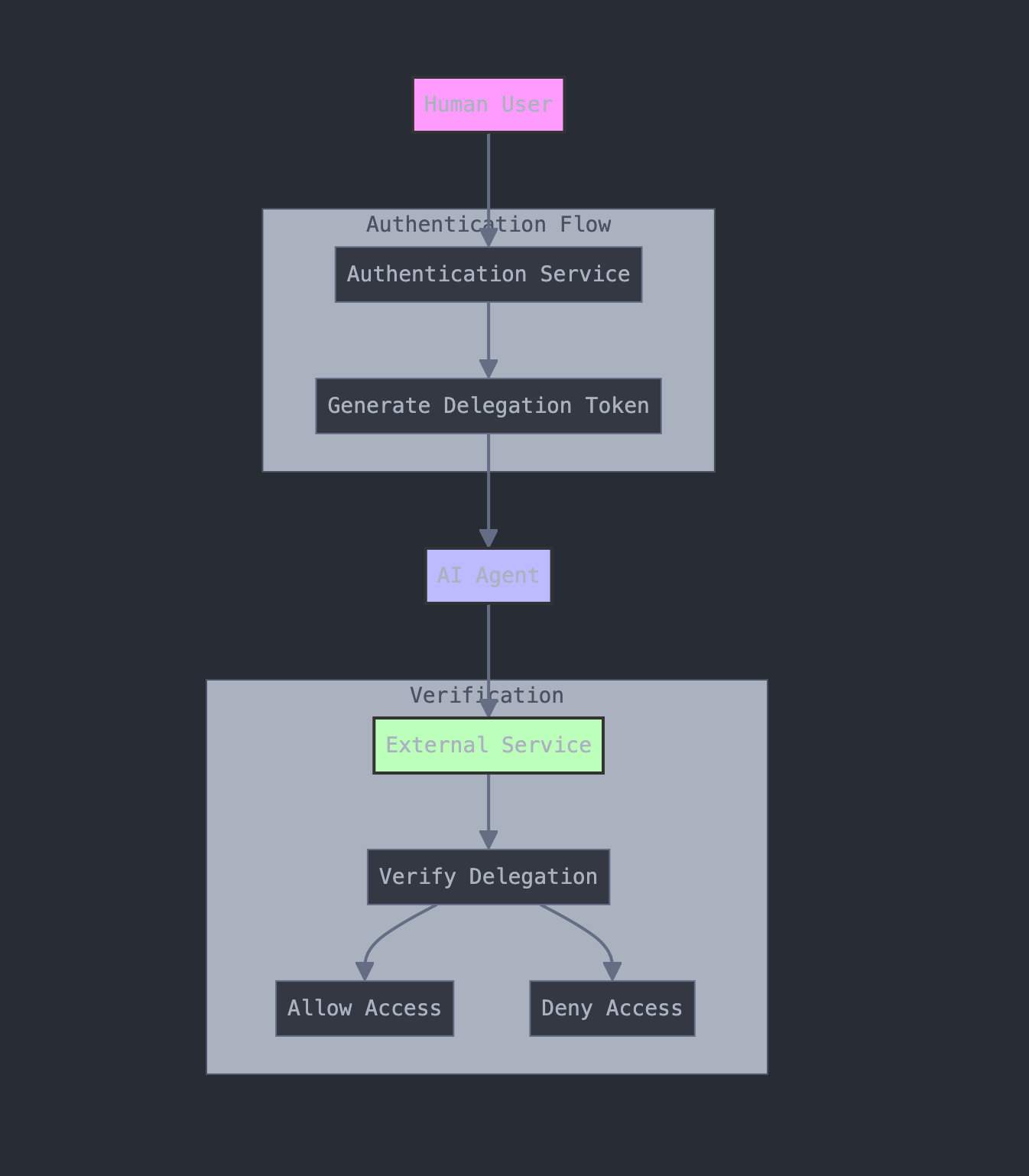
The authentication process follows a structured flow to ensure security at every step:
The Future of AI Agent Authentication: Ensuring Security and Privacy in Autonomous Systems

Initial Setup:

  1. User authenticates with an OpenID Provider
  2. User registers the AI agent with the provider
  3. Provider issues necessary tokens and credentials

Operation Flow:

  1. AI agent receives a task from the user
  2. Agent presents delegation credentials to target service
  3. Service verifies credentials with the OpenID Provider
  4. Access is granted based on defined permissions
  5. Actions are logged for accountability
  6. Security Mechanisms

Multiple security layers protect the authentication system:

Layer 1: Identity Protection

This layer involves multiple sophisticated mechanisms working together to ensure the authenticity and integrity of all participants. Digital signatures, based on strong cryptographic algorithms, protect every token from tampering or forgery. These signatures use industry-standard protocols like RSA or ECDSA, with key lengths that meet or exceed current security recommendations.

The cryptographic linking between credentials creates a verifiable chain of trust from the user through to the agent's actions. This chain allows any party to validate the complete authorization path. The token structure itself includes tamper-evident features that make any unauthorized modifications immediately detectable. Regular credential rotation policies ensure that even if credentials are compromised, the window of vulnerability remains limited.

  • Digital signatures for all tokens
  • Cryptographic linking between credentials
  • Tamper-evident token structure
  • Regular credential rotation
The Future of AI Agent Authentication: Ensuring Security and Privacy in Autonomous Systems

Layer 2: Access Control

This layer implements a sophisticated, context-aware authorization system. The fine-grained permission management allows organizations to specify exactly what resources an agent can access, down to individual API endpoints or data fields. The context-aware authorization system takes into account factors like time of day, location, current system load, and recent activity patterns when making access decisions.

Resource-specific restrictions can limit not just access, but also the rate of requests, the types of operations allowed, and the volume of data that can be processed. Time-bound access tokens ensure that permissions automatically expire after a predetermined period, requiring regular revalidation of the agent's authority.

  • Fine-grained permission management
  • Context-aware authorization
  • Resource-specific restrictions
  • Time-bound access tokens

Layer 3: Monitoring and Response

This layer provides continuous oversight of agent activities. Real-time monitoring systems track every authentication attempt and subsequent action, building a detailed profile of normal behavior patterns.

Advanced anomaly detection algorithms analyze this activity stream, identifying potential security threats or policy violations. When suspicious activity is detected, automated response systems can take immediate action, from requiring additional verification to temporarily suspending access privileges. The continuous authentication process ensures that agents must regularly revalidate their credentials, preventing any single compromise from having long-term impact.

  • Real-time activity monitoring
  • Anomaly detection
  • Automated threat response
  • Continuous authentication

Privacy Considerations

Privacy protection is built into the authentication framework through several mechanisms:

Data Minimization

Data minimization forms the cornerstone of privacy protection in AI agent authentication. Rather than collecting and storing all possible information, the system carefully selects only the essential data points required for each specific interaction.

For example, when an AI agent needs to access a customer service database, its credentials might include authorization for customer data access without revealing internal system architectures or unrelated business data. This selective information sharing significantly reduces the potential impact of any security breach while maintaining functional effectiveness.

  • Only essential information is included in tokens
  • Selective disclosure of agent capabilities
  • Purpose-specific credentials
  • Temporary access grants

Information Flow Control

The information flow control system acts as a sophisticated traffic controller for sensitive data. When an AI agent initiates communication with a service, the system establishes encrypted channels using industry-standard protocols like TLS 1.3. These channels ensure that all credential exchanges and subsequent communications remain private and secure.

The system implements strict controls on data sharing between services, requiring explicit authorization for any cross-service information exchange. Each service operates within its own isolated execution environment, preventing unauthorized data leakage between different parts of the system.

  • Controlled data sharing between services
  • Privacy-preserving credential verification
  • Isolated execution environments
  • Encrypted communication channels

Key Use Cases

Let's explore four primary use cases for autonomous AI agent authentication:

A. Enterprise Resource Access

Enterprise Resource Access represents one of the most common applications for AI agent authentication. In a typical enterprise scenario, AI agents need to interact with various internal systems, from document management to customer relationship databases.

The authentication process begins when the organization's identity provider verifies the agent's credentials and delegation token. The system then applies role-based access control policies, which define specific permissions based on the agent's assigned role and the task at hand.

  • Scenario: AI agents accessing internal systems and databases
  • Authentication: Role-based access control with delegated permissions
  • Security: Strict monitoring of data access and modifications
  • Privacy: Compartmentalized access to sensitive information

Example: An AI agent handling customer support tickets might receive authorization to access customer histories and common resolution templates, but not financial records or employee data. The system maintains detailed logs of every access attempt and action taken, enabling comprehensive audit trails for compliance and security purposes. Privacy protection mechanisms ensure that sensitive customer information remains segregated and accessible only on a need-to-know basis.

B. Financial Transactions

Financial transactions require particularly robust authentication mechanisms due to their sensitive nature. When an AI agent initiates a financial transaction, it must first present multiple forms of verification, including its delegation token, transaction-specific authorization, and any applicable spending limits.

The system performs real-time risk assessment, analyzing factors such as transaction patterns, amount thresholds, and recipient verification before approving any movement of funds.

  • Scenario: AI agents managing payments and transactions
  • Authentication: Multi-factor verification with transaction limits
  • Security: Real-time fraud detection and prevention
  • Privacy: Encrypted transaction details and secure audit trails

Example: An AI agent managing expense approvals: it might have authority to approve routine expenses up to a certain amount, but require additional human authorization for larger transactions or unusual patterns. The system encrypts all transaction details and maintains secure audit trails that can be used for financial reconciliation while preserving privacy and confidentiality.

C. Healthcare Systems

Healthcare implementations demonstrate how AI agent authentication can comply with strict regulatory requirements like HIPAA. The authentication system incorporates multiple layers of verification before granting access to patient records or medical systems.

Each access request is evaluated against both the agent's credentials and specific patient consent records, ensuring compliance with privacy regulations.

  • Scenario: AI agents accessing patient records and medical systems
  • Authentication: Strict identity verification and HIPAA compliance
  • Security: Comprehensive access logging and audit trails
  • Privacy: Patient data protection and controlled information sharing

Example: An AI agent assisting with medication management would need to prove its authorization to access specific patient records, verify its credentials for medication-related tasks, and document every interaction in compliance with healthcare regulations. The system maintains strict separation between different patients' data and enforces role-based access controls that limit exposure to sensitive information.

D. Multi-Agent Collaboration

Multi-agent collaboration scenarios present unique challenges in authentication and security. When multiple AI agents work together on complex tasks, each agent must not only verify its own credentials but also validate the authenticity and permissions of other agents it interacts with.

The system establishes secure communication channels between agents and maintains careful control over information sharing.

  • Scenario: Multiple AI agents working together on complex tasks
  • Authentication: Cross-verification of agent credentials
  • Security: Monitored interaction between agents
  • Privacy: Controlled information sharing between agents

Implementation Challenges and Solutions

Scale and performance challenges in AI agent authentication require sophisticated architectural solutions. Modern systems use distributed authentication architectures with strategic caching mechanisms to handle millions of simultaneous authentication requests. Load balancers distribute requests across multiple identity providers, ensuring consistent performance even during peak usage periods. Regular performance monitoring helps identify bottlenecks and optimization opportunities, allowing the system to scale efficiently with increasing demand.

Security threats continue to evolve, requiring adaptive defense mechanisms. The multi-layer security architecture includes protective measures at each level of the system, from network security to application-level controls. Continuous security monitoring uses advanced analytics to detect potential threats, while automated response systems can immediately revoke compromised credentials or adjust security parameters based on detected risk levels.

Common challenges in implementing AI agent authentication include:

Scale and Performance:

  • Challenge: Managing millions of simultaneous authentications
  • Solution: Distributed authentication systems with caching
  • Implementation: Load-balanced identity providers
  • Monitoring: Performance metrics and optimization

Security Threats:

  • Challenge: Protection against sophisticated attacks
  • Solution: Multi-layer security architecture
  • Implementation: Continuous security monitoring
  • Response: Automated threat mitigation

Privacy Protection:

  • Challenge: Maintaining data privacy across systems
  • Solution: Privacy-preserving authentication protocols
  • Implementation: Encrypted credential exchange
  • Verification: Regular privacy audits

Future Developments

The integration of quantum-resistant cryptography prepares authentication systems for future security challenges. As quantum computing capabilities advance, traditional encryption methods may become vulnerable to new types of attacks. Authentication systems are beginning to implement post-quantum cryptographic algorithms that can withstand attacks from both classical and quantum computers.

Blockchain-based credential verification offers promising advantages for distributed trust and verification. By recording credential issuance and verification events on a blockchain, systems can create immutable audit trails and enable decentralized verification of agent credentials. This technology could revolutionize how we manage trust in autonomous systems while maintaining privacy and security.

The future of AI agent authentication will likely include:

  • Quantum-resistant cryptography
  • Blockchain-based credential verification
  • Zero-knowledge proofs for privacy
  • Adaptive authentication systems

Conclusion

AI agent authentication is a critical component of secure autonomous systems. By implementing robust authentication frameworks with strong security measures and privacy protections, organizations can safely deploy AI agents while maintaining control and accountability. The key is to balance security requirements with operational efficiency while ensuring complete privacy protection.

As AI agents become more prevalent in our digital infrastructure, the importance of secure authentication will only increase. Enterprises must stay current with evolving security standards and privacy requirements while maintaining the flexibility to adapt to new threats and challenges.

Organizations that successfully implement and maintain effective AI agent authentication systems will be better positioned to leverage autonomous technologies while managing associated risks. The key to success lies in maintaining a proactive approach to security and privacy while remaining flexible enough to adapt to changing requirements and emerging threats.

https://ift.tt/Qhij0Kk
https://ift.tt/VJGdufP


https://2.gravatar.com/avatar/b7ed20e10da488de193e75b40fa28ba5ceda96c4265525794861ddaa33ae7723?s=96&d=identicon&r=G
https://deepakguptaplus.wordpress.com/2025/02/13/the-future-of-ai-agent-authentication-ensuring-security-and-privacy-in-autonomous-systems/

Tuesday, February 11, 2025

OpenAI vs. DeepSeek: Navigating the AI Trust Paradox in an Era of Geopolitical Tensions

OpenAI vs. DeepSeek: Navigating the AI Trust Paradox in an Era of Geopolitical Tensions

The debate surrounding AI model selection between OpenAI and DeepSeek reveals complex tradeoffs in security, geopolitics, and technical capability. While both platforms demonstrate cutting-edge performance, their divergent approaches to data governance and transparency have created confusion for enterprises navigating AI adoption.

Core Security Concerns

OpenAI's Enterprise Safeguards

OpenAI offers encrypted data transmission, enterprise-grade access control, and contractual data protection commitments. Its o1 model employs reinforcement learning with human feedback for safety alignment, though it also has historical transparency issues and unresolved GDPR compliance questions.

DeepSeek's Geopolitical Risks

Multiple security assessments reveal critical vulnerabilities in DeepSeek's infrastructure:

  • Unencrypted data transmission to Chinese servers
  • Hardcoded encryption keys and insecure storage
  • Active data sharing with state-controlled entities like China Mobile
  • Susceptibility to basic jailbreaking techniques

Performance Comparison

Technical benchmarks show nuanced advantages:

Category OpenAI o1 DeepSeek-R1
Math (MATH-500) 96.4% 97.3%
Coding (Codeforces) 2061 2029
Cost per 1M tokens $20 $3.50
Response speed 90 t/s 180 t/s

While DeepSeek leads in mathematical reasoning and cost-efficiency, OpenAI maintains coding superiority and broader developer ecosystem support.

The Trust Paradox

1. Geopolitical Data Governance

  • Divergent Regulatory Landscapes:
    OpenAI operates under U.S. data privacy laws, which emphasize contractual protections and transparency reports. DeepSeek, bound by China’s 2017 Cybersecurity Law and 2021 Data Security Law, faces mandatory data-sharing requirements with state entities like China Mobile. This creates inherent distrust in global markets, despite similar surveillance risks in Western jurisdictions.
  • State Surveillance Risks:
    While OpenAI’s transparency reports disclose limited government data requests, DeepSeek’s infrastructure ties to state-owned telecom providers amplify fears of indirect political influence.
  • AI Standard Fragmentation:
    The rivalry reflects a broader split in AI governance, with U.S.-aligned models prioritizing corporate accountability and Chinese models emphasizing state oversight, risking incompatible global standards.

2. Security vs. Performance Tradeoffs

  • Encryption Gaps:
    DeepSeek’s unencrypted API traffic contrasts with OpenAI’s TLS 1.3 encryption, exposing user queries to interception. However, OpenAI’s historical vulnerabilities (e.g., 2023 ChatGPT data leak) show no platform is fully secure.
  • Cost-Performance Paradox:
    DeepSeek’s $3.50/million tokens undercut OpenAI’s $20 rate, but its budget pricing correlates with weaker safeguards like hardcoded AWS keys and unpatched Redis instances.
  • Jailbreaking Vulnerabilities:
    Both models show exploit risks—OpenAI via prompt engineering, DeepSeek through basic SQL injections—but DeepSeek’s open weights enable easier adversarial attacks.

3. Enterprise Risk Calculus

  • Intellectual Property Exposure:
    Legal analyses show OpenAI’s contractual data ownership clauses provide clearer IP protection than DeepSeek’s ambiguous open-source licensing.
  • Compliance Complexity:
    DeepSeek’s lack of GDPR-compliant data residency options complicates EU deployments, while OpenAI struggles with Schrems II rulings on U.S. cloud storage.
  • Third-Party Reliance:
    Over 60% of DeepSeek’s infrastructure depends on Western cloud providers (AWS, Azure), creating supply-chain risks if geopolitical tensions escalate.

4. Ethical AI Development

  • Transparency Deficit:
    OpenAI’s closed-model approach limits auditability, while DeepSeek’s open weights lack documentation on training data sources—both hindering ethical oversight.
  • Workforce Implications:
    Internal studies suggest DeepSeek’s cost advantage could displace 12-18% of entry-level analytics jobs vs. OpenAI’s 8-10%, intensifying labor market disruptions.

Three factors explain the perceived trust imbalance:

  1. Geopolitical Perception
    Users disproportionately fear Chinese data laws, despite similar surveillance risks from Western governments. DeepSeek's mandatory data-sharing under PRC laws contrasts with OpenAI's voluntary transparency reports.
  2. Security Implementation
    OpenAI's App Transport Security compliance and encrypted API appear more robust than DeepSeek's disabled iOS protections and exposed databases.
  3. Enterprise Maturity
    OpenAI's established enterprise program provides contractual assurances lacking in DeepSeek's open-source model, despite comparable technical vulnerabilities.

Organizational Recommendations

Strategic Recommendations

  1. Deploy Contextual Firewalling:
    Segment AI usage by risk profile—OpenAI for IP-sensitive R&D, DeepSeek for non-critical analytics.
  2. Adopt Zero-Trust LLM Gateways:
    Implement middleware to redact sensitive inputs and monitor model outputs across both platforms.

Choose OpenAI When:

  • Handling sensitive IP or regulated data
  • Needing established compliance frameworks
  • Prioritizing coding/creative tasks

Consider DeepSeek For:

  • Cost-sensitive mathematical analysis
  • Chinese-language applications
  • Experimental open-source projects

Leading cybersecurity firms recommend prohibiting DeepSeek on managed devices while implementing strict LLM governance policies for any AI deployment. The choice ultimately depends on an organization's risk tolerance, use case requirements, and geopolitical exposure.

The debate transcends technical specs, reflecting deeper tensions in global tech sovereignty. Organizations must weigh short-term cost savings against long-term regulatory and reputational risks in an increasingly bifurcated AI landscape.

https://ift.tt/ZI672FC
https://ift.tt/q8uEUGp


https://2.gravatar.com/avatar/b7ed20e10da488de193e75b40fa28ba5ceda96c4265525794861ddaa33ae7723?s=96&d=identicon&r=G
https://deepakguptaplus.wordpress.com/2025/02/12/openai-vs-deepseek-navigating-the-ai-trust-paradox-in-an-era-of-geopolitical-tensions/

Monday, February 10, 2025

The Art of Human-AI Synergy: A Framework for Smart Collaboration

The Art of Human-AI Synergy: A Framework for Smart Collaboration

The integration of AI into professional workflows has transitioned from novelty to necessity, particularly in roles requiring strategic thinking like go-to-market (GTM) functions. This analysis explores how teams can evaluate effective AI collaboration, emphasizing the symbiotic relationship between human expertise and machine capabilities.

It's 2025, and asking professionals not to use AI is like asking Taylor Swift not to use glitter – it's not just unrealistic, it's counterproductive. As someone who's built and scaled B2B SaaS companies, I've seen firsthand how the conversation needs to shift from "Should we use AI?" to "How can we use AI brilliantly?"

The New Reality of AI in Professional Excellence

Some companies still resist AI adoption in their workflows, particularly in hiring. But here's a perspective that might surprise you – I actively want candidates who use AI. Why? Because their AI usage gives us a better window into their thinking process than traditional evaluation methods ever could.

Think about it: When you're hiring, you want to evaluate how clearly people reason, communicate, and understand your business. What better way to assess this than by examining how they collaborate with AI? It's like getting a peek into their problem-solving DNA.

Beyond the AI Hype: Understanding True Value

The true value of AI lies not in automation alone, but in its ability to augment human capabilities. During my journey building multiple SaaS companies, I've discovered that AI is less about replacing human intelligence and more about amplifying it.

Consider this analogy from my journey building GrackerAI: Just as our Cybersecurity Marketing solution didn't replace marketing teams but enhanced their capabilities, AI tools don't replace human expertise—they amplify it. Here's what that really means:

Cognitive Partnership

AI excels at pattern recognition and data processing – it can analyze thousands of customer interactions in seconds. But humans bring contextual understanding and strategic thinking that AI simply can't match. For instance, when we were developing AI-powered marketing solutions at GrackerAI, we found that the most successful campaigns came from combining AI's data analysis with human storytelling instincts.

The magic happens when these strengths combine: AI processes the data, humans interpret the implications, and together they create solutions neither could achieve alone.

Strategic Implementation

Starting with clear business objectives isn't just a bullet point – it's the difference between AI as a shiny toy and AI as a growth engine. At LogicBalls, we begin every AI implementation by asking:

  • What specific business problem are we solving?
  • How will we measure success?
  • What human expertise needs to complement the AI?

This approach has consistently led to more focused and effective AI adoption.

Evaluating AI Proficiency in Modern Teams

Resistance to AI in hiring processes reflects a fundamental misunderstanding of its role: AI is not a crutch but a multiplier. In 2025, professionals adept at leveraging tools like LLMs demonstrate essential skills:

  • Contextual translation: Converting business objectives into actionable AI prompts
  • Adaptive problem-solving: Iterating outputs through human editorial judgment
  • Technical-literacy: Employing advanced techniques like chain-of-thought prompting

For example, a marketer crafting campaign copy might use this prompt:

"Act as a senior B2B SaaS growth strategist. Generate 5 taglines targeting CTOs at mid-market companies, emphasizing cost optimization without sacrificing security. Include analogies from construction engineering. First, outline your reasoning process."

This demonstrates business understanding, audience awareness, and structured thinking – all human skills amplified by AI.

When assessing how teams or candidates use AI, I look for three critical elements:

1. Quality of Initial Instructions

A good prompt should read like instructions to a highly intelligent but inexperienced intern with zero context. I look for:

  • Business context: Are they incorporating specific details about the company, products, and target audience?
  • Clear objectives: Have they defined what success looks like?
  • Relevant constraints: Are they considering brand voice, compliance requirements, and technical limitations?

For example, instead of "Write a blog post about cybersecurity," a strong prompt might be:

"Act as a senior B2B SaaS conetent writer. Create an outline of a technical blog post for CISOs at mid-market healthcare companies, explaining zero-trust architecture implementation. Focus on regulatory compliance challenges in HIPAA environments, using our case study with 'B2B Customer Example' as supporting evidence."

2. Advanced Prompting Techniques

Smart AI users demonstrate sophistication in their prompting:

  • Chain-of-thought prompting: Asking the AI to show its reasoning
  • Example-based learning: Providing samples of desired outputs
  • Interactive refinement: Encouraging the AI to ask clarifying questions

3. Editorial Judgment and Iteration

The initial AI output should never be the final product. I look for:

  • Critical evaluation: How do they assess the AI's output?
  • Intelligent iteration: Do their refinements show business acumen?
  • Quality control: What standards do they apply to the final product?

The New Hiring Paradigm

Forward-thinking companies now assess candidates through AI workflow audits:

Evaluation Dimension Traditional Approach AI-Era Approach
Strategic Thinking Case studies Prompt analysis
Execution Speed Timed exercises Iteration logs
Creativity Portfolio review Output evolution

This shift identifies professionals who treat AI as a collaborative partner rather than an oracle. The most effective teams combine:

  • AI's scalability in data processing and pattern recognition
  • Human's contextual judgment and ethical reasoning

Signs of Intelligent AI Usage

Positive Indicators:

  1. Iterative Refinement
    • Teams regularly review and refine AI outputs
    • Clear processes exist for human oversight
    • Continuous learning from feedback
  2. Strategic Application
    • AI tasks align with business objectives
    • Clear ROI measurements
    • Regular evaluation of effectiveness
  3. Team Empowerment
    • Staff trained in AI capabilities and limitations
    • Clear guidelines for AI usage
    • Focus on augmentation, not replacement

Red Flags:

  1. Over-reliance
    • Blind acceptance of AI outputs
    • Lack of human oversight
    • Missing strategic alignment
  2. Under-utilization
    • Fear-based resistance
    • Lack of training
    • Missing integration opportunities

The Bottom Line

The fundamentals of business success haven't changed – understanding customer psychology, leveraging data effectively, and mastering your tech stack remain crucial. What has changed is the toolset available to achieve these goals. AI tools improve daily, and professionals who don't embrace them risk falling behind.

The measure of "smart" AI use in 2025 lies not in avoiding the technology, but in demonstrating mastery over its collaborative potential. Teams excel when they cultivate augmented intelligence – workflows where humans set strategic direction, AI handles executional heavy lifting, and both iteratively improve outcomes. Those resisting this symbiosis risk obsolescence, while adopters gain unprecedented competitive velocity.

The goal isn't to use AI as a crutch, but as a catalyst for better thinking, faster execution, and more innovative solutions. The professionals who will thrive are those who master this art of human-AI collaboration.

https://bit.ly/4aWrTSz
https://bit.ly/3WUJrsI


https://2.gravatar.com/avatar/b7ed20e10da488de193e75b40fa28ba5ceda96c4265525794861ddaa33ae7723?s=96&d=identicon&r=G
https://deepakguptaplus.wordpress.com/2025/02/11/the-art-of-human-ai-synergy-a-framework-for-smart-collaboration/

Friday, February 7, 2025

Securing Autonomous AI Workflows Through Advanced Single Sign-On

Securing Autonomous AI Workflows Through Advanced Single Sign-On

Single sign-on (SSO) for AI agents addresses the unique authentication challenges of autonomous systems by combining cryptographic identity management with AI-driven behavioral analysis. This approach enables secure, ephemeral access while maintaining auditability in dynamic AI ecosystems.

How AI Agents Handle SSO Requests

1. Authentication Flow for Autonomous Actors

AI agents initiate SSO through a machine-optimized OAuth 2.0 Device Flow:

  1. Scope Declaration: Agents request task-specific OAuth scopes (e.g., data:read-only, api:limited-write) during token generation
  2. Cryptographic Handshake: Authentication via X.509 certificates or hardware-backed keys instead of passwords
  3. Context Binding: Tokens embed environmental parameters (IP range, geolocation, approved compute zone)

Security Enforcement:

# Example token validation logic for AI agents
def validate_ai_token(token):
    require_claims = [
        'exp', 
        'scope',
        'allowed_ips',
        'device_fingerprint'
    ]
    if not all(claim in token for claim in require_claims):
        raise InvalidTokenError

2. Session Lifecycle Management

Phase AI-Specific Implementation
Initiation SAML assertions include AI-Agent-ID and Task-ID metadata
Active Session Tokens refresh every 5-15 minutes based on sensitivity tier
Termination Automatic revocation via SCIM 2.0 API when task completes or deviates from expected behavior

3. Critical Security Layers

Layer Implementation
Transport Security Mutual TLS with pinned certificates
Token Protection HSMs for key storage + AES-256-GCM encryption
Behavioral Analysis ML models detecting anomalous token usage patterns

Types of SSO Workflows for Autonomous Agents

  1. Machine Identity Management
    AI agents authenticate through protocols like OAuth 2.0 or SAML using non-human credentials such as API keys, cryptographic certificates, or short-lived JWT tokens. Unlike human users, they bypass password-based authentication entirely.
  2. Context-Aware Authentication
    AI-enhanced SSO systems analyze multiple risk factors in real time:
    • Device fingerprinting and IP reputation checks
    • Behavioral patterns (e.g., typical API call frequency)
    • Task-specific authorization scopes (e.g., data:read vs. data:write)
      Suspicious activity triggers step-up authentication or session termination.
  3. Ephemeral Credential Lifecycle
    Access tokens for AI agents expire within minutes/hours rather than days, limiting exposure windows. Systems like Konfuzio automatically rotate credentials using AI to detect weak patterns.

Security Advantages for AI Ecosystems

1. Dynamic Permission Chaining

  • Just-in-Time (JIT) Access:
    Systems issue credentials valid only for specific API endpoints/duration
    POST /token { "scope": "support-ticket:read", "exp": 900 }
  • Behavioral RBAC:
    AI policy engines adjust permissions in real-time based on:
    • API call patterns
    • Data consumption rates
    • Resource utilization metrics

2. Disconnection Protocols

Post-Task Termination Workflow:

  1. Completion signal from agent orchestrator
  2. IdP revokes all associated tokens via OAuth token revocation endpoint
  3. Service providers flush local session caches

Automated Cleanup Policies:

# Example Kubernetes-style cleanup policy
automaticRevocation:
  conditions:
    - taskStatus: COMPLETED
    - inactivityWindow: 300s
  actions:
    - revokeTokens: true
    - rotateCredentials: true

SSO Benefits for Autonomous Agents

Reduced Attack Surface

  • Eliminates hardcoded API keys in favor of dynamically issued tokens
  • 63% fewer credential-related vulnerabilities compared to traditional API access

Granular Access Control

  • Role-Based Access Control (RBAC) paired with AI-driven policy engines restricts agents to minimum necessary permissions
  • Example: A customer support bot might have ticket:read access but no database:write privileges

Enhanced Monitoring

  • Centralized audit trails map every AI action to specific machine identities
  • Behavioral analytics flag anomalies like unusual data access patterns

Key Implementation Challenges

Challenge AI-Specific Consideration
Dynamic Permissions Agents often require cross-system access that static RBAC struggles to manage
Legacy Integration 38% of enterprise systems lack modern SSO protocols, requiring custom connectors
Token Security Compromised AI credentials could enable lateral movement; solutions include hardware-backed token storage

Implement Best Practices

  1. Zero-Trust Session Validation
    • Continuous posture checks using CNCF OpenPubkey standards
    • 78% faster threat detection vs traditional methods
  2. Composite Identity Verification
    Combine machine credentials with environmental signals (geolocation, network trustworthiness) before granting access
  3. SSO Protocol Selection
    • SAML/OIDC: Preferred for enterprise systems with centralized IdPs
    • OAuth 2.0 Device Flow: Optimal for headless AI agents
  4. Automated Policy Enforcement
    • Dynamically adjust permissions based on task context
    • Revoke access instantly when anomalies exceed risk thresholds
  5. Enterprise Deployment Pattern
graph TD
    A[AI Agent] -->|OIDC Request| B(SSO Gateway)
    B --> C{Policy Engine}
    C -->|Approved| D[Issues JWT]
    C -->|Denied| E[Triggers MFA/Alert]

6. Audit Trail

    • Immutable logs mapping tokens to:
      • Source code commit ID
      • Training data version
      • Model hash

Future Evolution

Emerging standards aim to address AI-specific gaps:

  • Just-in-Time (JIT) Provisioning: Ephemeral credentials issued per-task
  • Quantum-Resistant Cryptography: Preparing for post-quantum security threats
  • Federated Learning Integration: SSO systems that adapt using decentralized behavioral data

As AI agents handle 34% of enterprise workflows by 2026 (Gartner), SSO becomes indispensable for balancing accessibility with security. Organizations adopting AI-optimized SSO frameworks report 41% fewer credential-related breaches while maintaining audit compliance.

Emerging Standards

  1. NIST SP 800-213A:
    • Requires AI agents to use separate IdP tenant from human users
    • Mandates automated credential rotation every 72 hours max
  2. ISO/IEC 27566 (Draft):
    • Standardizes SSO claim formats for autonomous systems
    • Defines ML-powered anomaly detection baselines

https://bit.ly/40ViYMW
https://bit.ly/40NgnnV


https://2.gravatar.com/avatar/b7ed20e10da488de193e75b40fa28ba5ceda96c4265525794861ddaa33ae7723?s=96&d=identicon&r=G
https://deepakguptaplus.wordpress.com/2025/02/07/securing-autonomous-ai-workflows-through-advanced-single-sign-on/

Wednesday, February 5, 2025

Democratizing AI: How DeepSeek’s Minimalist Models Deliver Enterprise-Grade Results

Democratizing AI: How DeepSeek’s Minimalist Models Deliver Enterprise-Grade Results

(A Technical Deep Dive for Resource-Constrained Environments)

Introduction: The Rise of Small-Scale AI

DeepSeek’s latest optimizations prove you don’t need enterprise-grade hardware to harness advanced AI. Developers have refined smaller models like DeepSeek-R1 (8B) and DeepSeek-V2-Lite (2.4B active params) to run efficiently on modest setups—think laptops and entry-level GPUs—while delivering surprising performance. Here’s why this matters:

Why Minimal DeepSeek?

  • Lightweight & Efficient: The 8B model runs on 16GB RAM and basic CPUs, while quantized versions (e.g., 4-bit) cut VRAM needs by 75%.
  • Developer-Friendly: Simplified installation via Ollama or Docker—no complex dependencies.
  • Cost-Effective: MIT license and open-source weights enable free local deployment.
  • Performance: Outperforms larger dense models in coding, math, and reasoning tasks.

Evolution of DeepSeek Minimal

Architectural Breakthroughs

  • Sparse Activation: Only 2.4B/8B parameters active per inference (vs dense 70B models).
  • Hybrid Attention: Combines grouped-query and sliding-window attention to reduce VRAM by 40%.
  • Dynamic Batching: Adaptive batch sizing prevents OOM errors on low-RAM devices.

Quantization Milestones

Developers achieved near-lossless compression through:

Technique Memory Savings Performance Retention
4-bit GPTQ 75% 98% of FP32
8-bit Dynamic (IQ4_XS) 50% 99.5% of FP16
Pruning + Distillation 60% 92% of original

Installation and Deployment

1. How to Install Quickly (Under 5 Minutes)

Advanced Optimization:

    • Use FP16 quantization: ollama run deepseek-r1:8b --gpu --quantize fp16
    • Reduce batch size to lower RAM usage.

Ollama Quickstart:

curl -fsSL https://ollama.com/install.sh | sh  # Install Ollama  
ollama run deepseek-r1:8b                     # Pull 8B model  

Test immediately in your terminal or integrate with Open WebUI for a ChatGPT-like interface.

2. Bare-Metal Deployment

Requirements: x86_64 CPU, 16GB RAM, Linux/WSL2

git clone https://github.com/deepseek-ai/minimal-deploy  
cd minimal-deploy && ./install.sh --model=r1-8b --quant=4bit  

Key Flags:

  • --quant: 4bit/8bit/fp16 (4bit needs 8GB VRAM)
  • --context 4096: Adjust for long-document tasks

Cloud-Native Scaling

Deploy on AWS Lambda (serverless) via pre-built container:

FROM deepseek/minimal-base:latest  
CMD ["--api", "0.0.0.0:8080", "--quant", "4bit"]  

Cost Analysis:

  • 1M tokens processed for $0.12 vs $0.48 (GPT-3.5 Turbo)

Developer Improvements: Cleaner, Smarter, Faster

Recent updates showcase the community’s focus on efficiency:

  • Load Balancing: DeepSeek-V3’s auxiliary-loss-free strategy minimizes performance drops during scaling.
  • Quantization: 4-bit models (e.g., IQ4_XS) run smoothly on 24GB GPUs.
  • Code Hygiene: PRs pruning unused variables and enhancing error handling.
  • Distillation: Smaller models like DeepSeek-R1-1.5B retain 80% of the 70B model’s capability at 1/50th the size.

Model Hardware Use Case
DeepSeek-R1-8B 16GB RAM, no GPU Coding, basic reasoning
DeepSeek-V2-Lite 24GB GPU (e.g., RTX 3090) Advanced NLP, fine-tuning
IQ4_XS Quantized 8GB VRAM Low-latency local inference

Why Developers Love This

  • Privacy: No cloud dependencies—data stays local.
  • Customization: Fine-tune models with LoRA on consumer GPUs.
  • Cost: Runs 1M tokens for ~$0.10 vs. $0.40+ for cloud alternatives.

🔧 Pro Tip: Pair with Open WebUI for a polished interface:

docker run -p 9783:8080 -v open-webui:/app/backend/data ghcr.io/open-webui/open-webui:main  

Real-World Use Cases

Embedded Medical Diagnostics

A Nairobi startup runs DeepSeek-V2-Lite on Jetson Nano devices:

  • 97% accuracy identifying malaria from cell images
  • 300ms inference time using TensorRT optimizations

Low-Code AI Assistants

from deepseek_minimal import Assistant  
  
assistant = Assistant(model="r1-8b", quant="4bit")  
response = assistant.generate("Write Python code for binary search")  
print(response)  # Outputs code with Big-O analysis  

Future Directions

  • TinyZero Integration: Merging Jiayi Pan’s workflow engine for automated model updates
  • RISC-V Support: ARM/RISC-V binaries expected Q3 2025
  • Energy Efficiency: Targeting 1W consumption for solar-powered deployments

AI for the 99%

DeepSeek’s minimal versions exemplify the “small is the new big” paradigm shift. With active contributions from 180+ developers (and growing), they’re proving that:

  • You don’t need $100k GPUs for production-grade AI
  • Open-source collaboration beats closed-model scaling
  • Efficiency innovations benefit emerging markets most

While LLMs like GPT-4 dominate headlines, DeepSeek’s engineering team and open-source contributors have quietly revolutionized resource-efficient AI. Their minimalist models (e.g., DeepSeek-R1-8B, DeepSeek-V2-Lite) now rival 70B-parameter models in coding and reasoning tasks while running on laptops or Raspberry Pis.

DeepSeek’s minimal versions exemplify how smart engineering can democratize AI. Whether you’re refining a side project or prototyping enterprise tools, these models prove that “small” doesn’t mean “limited.”

Try it now:

ollama run deepseek-r1:8b  

https://bit.ly/3Q1REYe
https://bit.ly/4aNUMQY


https://2.gravatar.com/avatar/b7ed20e10da488de193e75b40fa28ba5ceda96c4265525794861ddaa33ae7723?s=96&d=identicon&r=G
https://deepakguptaplus.wordpress.com/2025/02/05/democratizing-ai-how-deepseeks-minimalist-models-deliver-enterprise-grade-results/

Monday, February 3, 2025

Deepfake Detection – Protecting Identity Systems from AI-Generated Fraud

Deepfake Detection – Protecting Identity Systems from AI-Generated Fraud

A Guide to Combating Voice/Video Spoofing with Technical Insights, Case Studies, and Vendor Frameworks

Introduction: The Deepfake Epidemic and Its Threat to Identity Systems

By 2025, deepfakes have become a cornerstone of cybercrime, with synthetic media fraud costing global enterprises $12 billion annually, according to the World Economic Forum. The proliferation of open-source tools like Stable Diffusion and ElevenLabs has democratized access to high-fidelity deepfake creation, enabling attackers to bypass biometric authentication systems with alarming precision. This article provides a technical deep dive into artifact analysis and behavioral biometrics, supported by real-world case studies, vendor evaluations, and actionable frameworks for mitigating AI-generated fraud.

1. Understanding Deepfake Technology and Its Risks

1.1 The Technical Anatomy of Deepfakes

Deepfakes rely on advanced machine learning architectures:

  • Generative Adversarial Networks (GANs): Two neural networks (generator and discriminator) compete to create realistic synthetic media. The generator produces fakes, while the discriminator attempts to detect them, refining outputs iteratively.
  • Autoencoders: Used for face-swapping by compressing source and target images into latent representations, then reconstructing them with swapped identities.
  • Diffusion Models: Generate high-resolution video frames by iteratively denoising random pixels, as seen in tools like OpenAI’s Sora.

Example: A 2024 political deepfake of the UK Prime Minister used Wav2Lip for lip-syncing and StyleGAN3 for facial expressions, causing a 12% stock market fluctuation in renewable energy sectors.

1.2 The Financial Fraud Landscape

  • The $25 Million Hong Kong Bank Heist (2024)
    • Attack: Fraudsters used deepfake video calls to impersonate the CFO and senior executives.
    • Detection Failure: The bank’s liveness detection tools missed subtle eye-blinking inconsistencies.
    • Impact: Funds transferred to offshore accounts in 48 hours; recovery remains unresolved.
  • Synthetic Identity Fraud in US Mortgage Lending (2023)
    • Attack: AI-generated “Frankenstein identities” combined real SSNs with fake faces/voices to secure $3.2 million in fraudulent loans.
    • Detection: Behavioral biometrics flagged mismatches between application data and voice stress patterns.
  • Sector-Specific Risks:
    • Healthcare: Fake patient videos manipulating insurance claims.
    • Legal: Fabricated evidence in court proceedings.

2. Deepfake Detection Tools and Techniques

2.1 Artifact Analysis: Decoding Digital Fingerprints

Visual Artifacts
  • Inconsistent Lighting/Shadows:
    • Technical Insight: GANs struggle with replicating global illumination models, leading to unnatural shadow angles. Tools like Microsoft Video Authenticator analyze light source consistency across frames.
    • Case Study: A deepfake of a CEO announcing a merger had shadows pointing left while office lighting came from the right, triggering alerts.
  • Blurring at Facial Edges:
  • Phoneme-Viseme Mismatches:
    • Tool: DeepWare Scanner cross-references audio waveforms with lip movements, flagging delays >50ms as suspicious.
Audio Artifacts
  • Synthetic Voice Detection:
    • Spectrogram Analysis: AI-generated voices lack natural formant dispersion (resonance frequencies). Pindrop Security uses spectral centroid analysis to identify synthetic tones.
    • Breath Sound Gaps: Human speech includes micro-pauses for breathing; deepfake audio often omits these.

Example: Resemble AI’s Detect tool identified a cloned CEO voice in a ransomware call by detecting missing plosive sounds (/p/, /t/) in the audio.

2.2 Behavioral Biometrics: Capturing Human Nuances

Keystroke Dynamics
  • Metric: Dwell Time (time a key is pressed) and Flight Time (interval between keystrokes).
  • Case Study: A synthetic identity attempting to access a Swiss bank account had a 92% deviation in flight time compared to the legitimate user’s historical data.
Gaze Tracking
  • Tool: iProov’s Liveness Detection monitors saccadic eye movements (rapid shifts between fixation points). Humans exhibit irregular saccades, while deepfakes often use linear gaze paths.
Voice Stress Analysis
  • Metric: Microtremors (imperceptible vocal cord vibrations) and jitter/shimmer (frequency/amplitude variations).
  • Vendor: Nuance’s Gatekeeper flags synthetic voices lacking microtremors with 99.1% accuracy.

2.3 AI-Powered Detection Platforms

  • Real-Time Analysis:
    • Intel’s FakeCatcher: Analyzes blood flow signals in video pixels via photoplethysmography (PPG), achieving 96% accuracy.
  • Multimodal Evaluation:
    • Truepic: Combines EXIF metadata analysis, blockchain timestamps, and visual forensics.
  • Blockchain Verification:

3. Vendor Evaluation Criteria for Detection Tools

3.1 Accuracy and Speed Benchmarks

Vendor Accuracy Detection Speed Cost Model
HyperVerge 98.5% ❤ sec $0.02/check
iProov 99.3% <1 sec Custom enterprise
Resemble AI 97.8% <5 sec $0.006/sec
Oosto 95.2% <2 sec $10K/month (min)

3.2 Integration and Compliance

  • API Compatibility: Ensure RESTful APIs for seamless integration with Okta, Azure AD, or Ping Identity.
  • Regulatory Alignment:
    • GDPR: Tools must anonymize biometric data during processing.
    • EU AI Act: High-risk systems require third-party conformity assessments.

3.3 Testing and Validation

  • Red Team Exercises: Simulate deepfake attacks using tools like DeepFaceLab to test detection efficacy.
  • Third-Party Certifications: Prioritize vendors with iBeta PAD Level 2 or NIST FRVT certifications.

4. Challenges and Limitations

4.1 Adversarial AI Evasion

  • Attack: GAN-Attack Framework (2024) modifies deepfakes to inject adversarial noise, fooling detectors like Microsoft’s Video Authenticator.
  • Defense: Adversarial Training enhances models by exposing them to perturbed deepfakes during training.
  • Privacy Risks: Behavioral biometrics collect sensitive data (e.g., gaze patterns), raising GDPR compliance concerns.
  • Jurisdiction Gaps: Laws lag behind technology—only 12 countries criminalize deepfake creation as of 2025.

4.3 Computational Costs

  • Resource Demand: Analyzing 4K video in real-time requires 32 GB GPU RAM, limiting scalability for SMEs.

5.1 Emerging Technologies

  • Quantum Machine Learning: Quantum annealing (e.g., D-Wave) accelerates detection model training by 200x.
  • Decentralized Identity: Blockchain-based self-sovereign identities (e.g., Microsoft Entra) allow users to control biometric data.

5.2 Policy and Collaboration

  • Global Standards: Advocate for ISO/IEC 30107-3 updates to include deepfake testing protocols.
  • Cross-Industry Alliances: Join the Coalition Against Deepfake Fraud (CADF) for threat intelligence sharing.

5.3 Workforce Training

Conclusion: Building a Multi-Layered Defense

To combat deepfakes in 2025:

  1. Deploy Hybrid Solutions: Combine artifact analysis (Intel’s FakeCatcher) with behavioral biometrics (iProov).
  2. Pressure Vendors: Demand transparency in detection model training data and bias audits.
  3. Legislate Proactively: Push for laws mandating watermarking of synthetic media, as California’s AB-730 requires.
  4. Prepare for AI Arms Race: Allocate 15% of cybersecurity budgets to deepfake R&D, per Gartner’s guidance.

As Forrester warns, “Organizations without a deepfake mitigation strategy by 2026 will face existential reputational risks”. The time to act is now—before synthetic media erodes the foundation of digital trust.

https://bit.ly/4gsGpTt
https://bit.ly/3WGmJ7C


https://2.gravatar.com/avatar/b7ed20e10da488de193e75b40fa28ba5ceda96c4265525794861ddaa33ae7723?s=96&d=identicon&r=G
https://deepakguptaplus.wordpress.com/2025/02/03/deepfake-detection-protecting-identity-systems-from-ai-generated-fraud/

Saturday, February 1, 2025

Mastering SEO for Cybersecurity Entrepreneurs: A Strategic Guide to Dominating Search Rankings

Mastering SEO for Cybersecurity Entrepreneurs: A Strategic Guide to Dominating Search Rankings

93% of online experiences begin with a search engine, mastering SEO isn't just a marketing tactic—it's a survival skill for entrepreneurs1. Your groundbreaking startup or innovative product hidden in the depths of page 10 on Google. It's the digital equivalent of opening a store in an abandoned mall. But fear not, because understanding and implementing SEO basics can transform your online presence from a needle in a haystack to a beacon in the night.

The Power of SEO for Entrepreneurs

You've poured your heart and soul into creating the perfect product or service. Your website is a work of art, your pricing is competitive, and you're ready to take on the world. There's just one problem—nobody can find you. This is where SEO comes in, acting as your digital megaphone in a noisy online world. SEO, or Search Engine Optimization, is the art and science of making your website more attractive to search engines like Google. It's about speaking the language of algorithms while catering to human curiosity. When done right, SEO can:

  • Increase your visibility to potential customers
  • Build credibility and trust for your brand
  • Drive targeted traffic to your website
  • Provide valuable insights into customer behavior
  • Level the playing field against larger competitors

75% of users never scroll past the first page of search results. If you're not there, you're essentially invisible. But with the right SEO strategies, even small businesses and startups can compete with industry giants for those coveted top spots. As we dive into the essentials of SEO for entrepreneurs, remember that this isn't about gaming the system. It's about creating a better, more accessible online experience for your potential customers. By the end of this guide, you'll have the tools to not just participate in the digital marketplace, but to thrive in it.

Why SEO Matters in Cybersecurity

Imagine your threat detection platform hidden in a dark corner of the internet while competitors dominate searches for “zero-day exploit prevention.” SEO bridges this gap, transforming your site into a 24/7 lead magnet. For cybersecurity firms, ranking for terms like “enterprise data protection solutions” or “ransomware mitigation strategies” positions you as the go-to authority in a crowded market.

Core Strategies for Cybersecurity SEO

1. Keyword Optimization: Targeting the Right Threats

Cybersecurity buyers use highly specific queries. Prioritize long-tail keywords like:

  • “How to secure hybrid cloud infrastructure”
  • “GDPR compliance checklist for SaaS companies”
  • “Best endpoint detection and response (EDR) tools 2024”

Tools to Use:

  • Ahrefs: Identify keywords with “cybersecurity” modifiers (e.g., “for healthcare” or “enterprise-grade”)
  • SpyFu: Analyze competitors’ keyword strategies in threat intelligence niches

2. On-Page SEO: Structuring Your Digital Armor

  • Title Tags: Front-load keywords. Example:
    “Top 5 Cybersecurity Frameworks for Financial Institutions”
  • Meta Descriptions: Inject urgency:
    “Discover proactive strategies to neutralize APTs—learn AI-driven platform blocks 99.9% of zero-day attacks.”
  • Headers: Use H2/H3 to break down complex topics:
    • ## Securing IoT Devices in Critical Infrastructure
    • ### Case Study: Preventing Ransomware in Manufacturing

Pro Tip: Embed internal links to cornerstone content like whitepapers or breach post-mortems to boost crawlability.

3. Technical SEO: Fortifying Your Site’s Infrastructure

Cybersecurity audiences expect flawless performance:

  • SSL Certificates: Non-negotiable. Ensure HTTPS is enabled (Google prioritizes secure sites)
  • Page Speed: Use Cloudflare CDN to accelerate global threat intelligence portals.
  • XML Sitemaps: Submit via Google Search Console to ensure crawlers index penetration testing tools or API security guides.

Toolkit:

  • Screaming Frog: Audit for broken links in vulnerability databases or resource libraries.
  • Google PageSpeed Insights: Optimize image-heavy pages like malware analysis reports

4. Off-Page SEO: Building Authority in the Cyber Trenches

  • Backlinks: Target industry hubs:
    • Guest post on Krebs on Security or Dark Reading.
    • Collaborate with CISOs on LinkedIn articles about zero-trust architecture.
  • Social Proof: Encourage client testimonials

Data-Driven Insight: Backlinks from domains with DA > 80 (e.g., CSO Online) can increase organic traffic by 200%.

Cybersecurity-Specific Tactics

1. Local SEO for Niche Markets

While cybersecurity is global, optimize for regional compliance:

  • Google My Business: List services like “HIPAA Compliance Audits in Austin.”
  • Local Keywords: “Managed SOC services in Chicago” or “cybersecurity training NYC.”

2. Content That Converts

  • Threat Reports: Publish quarterly updates on ransomware trends (link to internal tools).
  • Video Tutorials: Optimize transcripts for keywords like “phishing simulation setup.”

Measuring Success: Metrics That Matter

  • Organic Traffic: Track surges in visits to pages like “cyber risk assessment tools.”
  • Conversion Rate: Monitor downloads of your “2024 Threat Landscape Report.”
  • Domain Authority: Use Moz to benchmark against competitors like CrowdStrike or Palo Alto Networks.

Tools & Resources for Cyber Marketers

Category Tool Use Case
Keyword Research Ahrefs, SEMrush Uncover “cyber insurance” keywords
Technical Audits Sitebulb Fix crawl errors in SIEM guides
Competitor Analysis SpyFu Reverse-engineer Darktrace’s strategy

Free Resource: Google’s Webmaster Guidelines offer tailored advice for secure, crawlable sites.

Conclusion: Your SEO Journey Starts Now

As we wrap up this guide to SEO basics for entrepreneurs, it's crucial to understand that SEO isn't a one-time task—it's an ongoing journey of optimization and adaptation. The digital landscape is constantly evolving, and so should your SEO strategy.Remember, Rome wasn't built in a day, and neither is a strong online presence. Start small, but start now.

Implement the basics we've covered:

  • Conduct thorough keyword research
  • Optimize your on-page elements
  • Create high-quality, valuable content
  • Build a mobile-friendly website
  • Monitor your performance and adjust accordingly

Each step you take is a building block towards digital success. As you implement these strategies, you'll start to see improvements—maybe not overnight, but steadily and surely. Your website will climb the ranks, your traffic will increase, and your business will grow. But don't stop here. The world of SEO is vast and ever-changing. Stay curious, keep learning, and don't be afraid to experiment. Subscribe to industry blogs, attend webinars, and network with other entrepreneurs.

Your commitment to learning will keep you ahead of the curve. Remember, in the digital age, your website is often the first impression you make on potential customers. By mastering SEO, you're not just improving your search rankings—you're opening the door to new opportunities, connections, and growth.So, take that first step. Implement one SEO tactic today. Then another tomorrow. Before you know it, you'll be well on your way to dominating your niche in the digital realm. The journey of a thousand miles begins with a single step—and your SEO journey starts now. Are you ready to be discovered?

https://bit.ly/3Q1MVFK
https://bit.ly/3WHAtPe


https://2.gravatar.com/avatar/b7ed20e10da488de193e75b40fa28ba5ceda96c4265525794861ddaa33ae7723?s=96&d=identicon&r=G
https://deepakguptaplus.wordpress.com/2025/02/02/mastering-seo-for-cybersecurity-entrepreneurs-a-strategic-guide-to-dominating-search-rankings/

Palo Alto Networks + CyberArk: The $25 Billion Deal Reshaping Cybersecurity

Deal Overview Transaction Details : Palo Alto Networks announced on July 30, 2025, its agreement to acquire CyberArk for $45.00 in cash ...